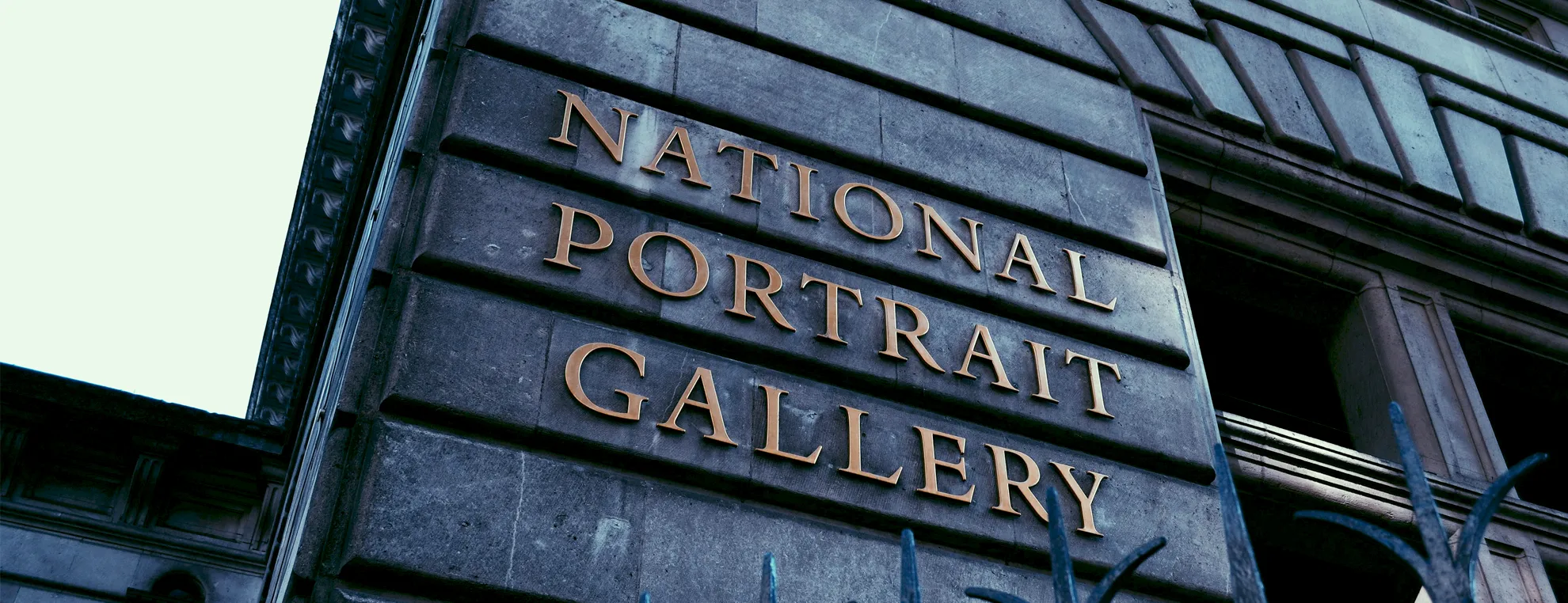
It’s interesting to think that, as an abstract portrait artist, I only visited the National Portrait Gallery for the first time last week.
What I found even more interesting was that, standing in such a prestigious London gallery, I found myself asking more questions about paintings than I think I ever have before and many of those questions started in the Herbert Smith Freehills Kramer Portrait Award 2026.
Looking at the incredibly varied selection of portraits, I found myself asking: Why did one painting grab my attention while another didn't? Why had one artist chosen to leave large areas barely painted? Why green? Why had some of the paintings I didn't particularly like been selected at all? The more I looked, the more questions seemed to appear, with each painting taking my thoughts in a different direction.
I was particularly drawn to Gabriel Choto's All You Need, a painting of two figures embracing where much of their clothing had been reduced to little more than an outline. I loved the bravery of that decision. Why choose to leave so much of it as just a suggestion? Would adding more detail actually take something away? Was the artist controlling where I looked simply by deciding what not to paint?
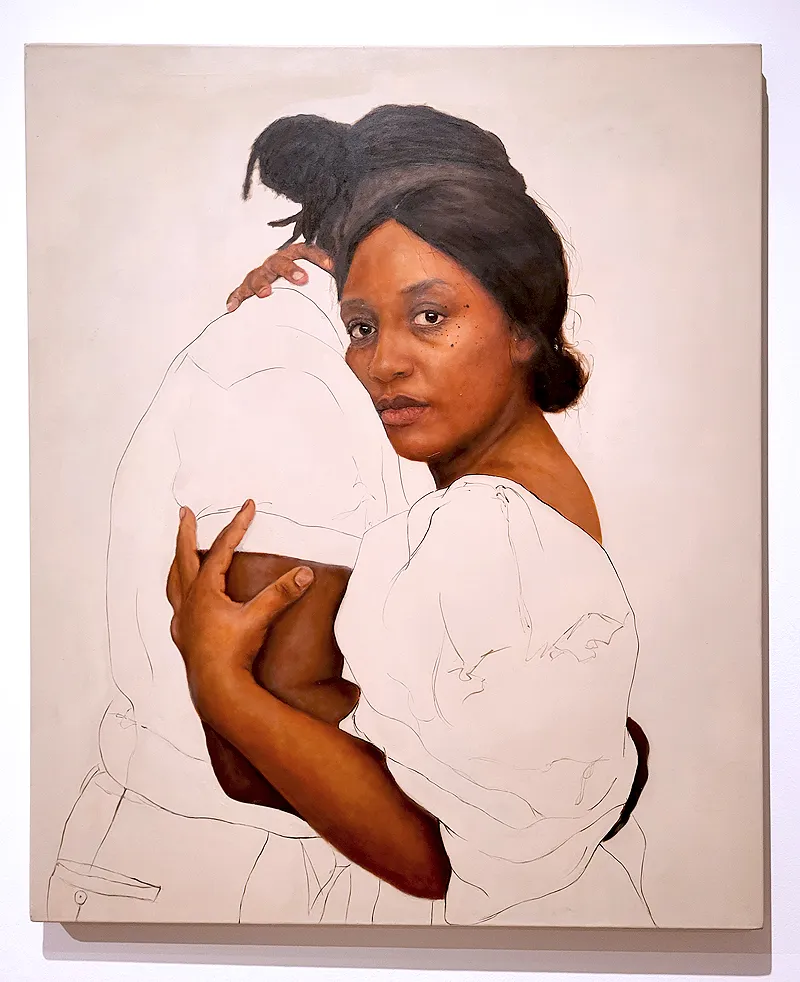
All You Need by Gabriel Choto, oil on canvas, 2024
Then there was colour. In Michael Slusakowicz's Charlie and Magda, both faces were green. There wasn't anything subtle about it, and I immediately wanted to know why. Was there a meaning behind it? Was it about mood? Did green simply work better with the other colours in the painting? More importantly, would I have spent anywhere near as long looking at it if the artist had used realistic skin tones?
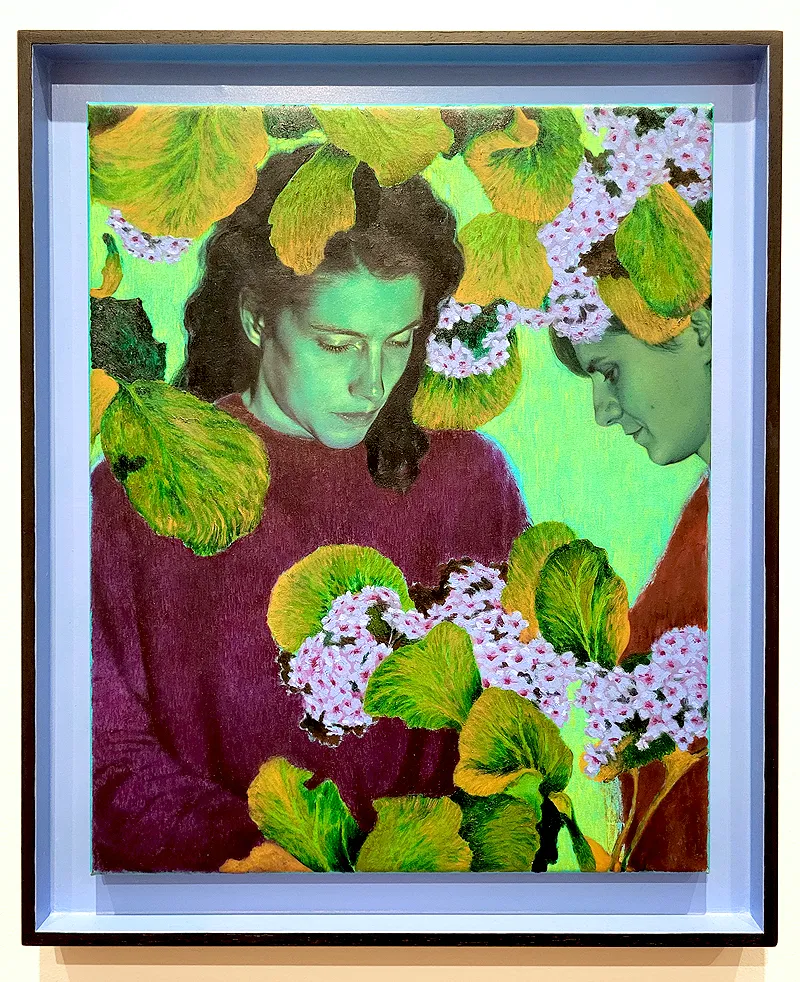
Charlie and Magda by Michael Slusakowicz, oil on canvas, 2026
Portrait of a Landlord by Sam Clayden grabbed me for a completely different reason. It was the lighting and atmosphere that initially drew me in, but knowing that the sitter was actually the landlord of the pub made me think about how much of a portrait is really about the person being painted. How much can the surroundings tell us about them? Take him out of that environment and paint exactly the same face against a plain background and would I feel the same thing? Would I know anything about him beyond what he looked like? Probably not.
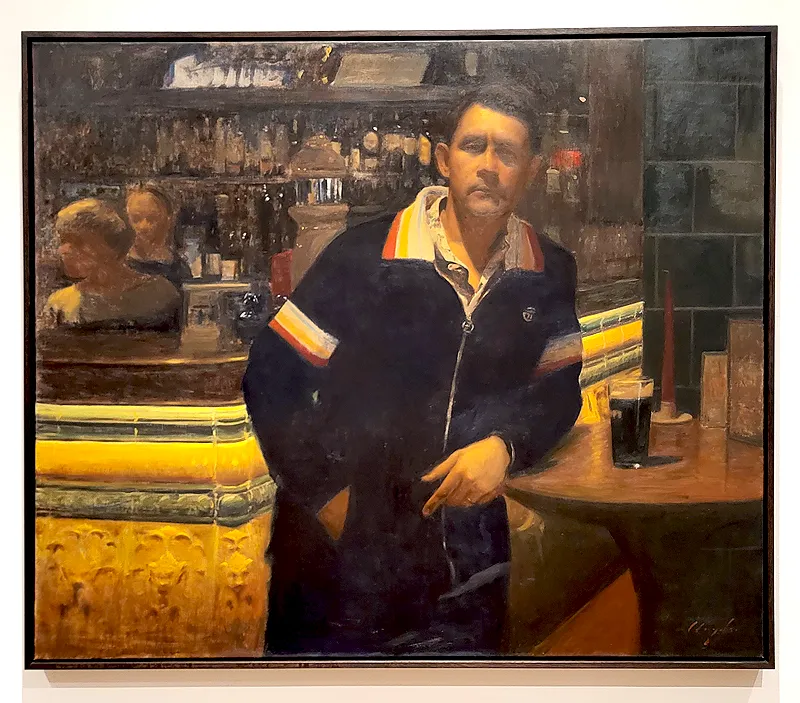
Portrait of a Landlord by Sam Clayden, oil on canvas, 2025
Useless, Part II by Karin Neijenhuis took me somewhere else entirely. It's a self-portrait based around something as mundane as ironing, which made me wonder what actually makes a moment worthy of becoming a painting. Does anything need to happen at all, or can the everyday be interesting simply because an artist chooses to make us look at it?
The composition interested me just as much. The underside of the ironing board cuts straight across the painting, obscuring much of the figure and taking up a huge amount of the canvas. It's probably not a composition I would ever have thought of, but that's partly why I found it interesting. Why put something so ordinary so prominently in front of the person you're supposedly painting? Would the portrait be anywhere near as interesting if she'd simply painted herself sitting beside an ironing board?
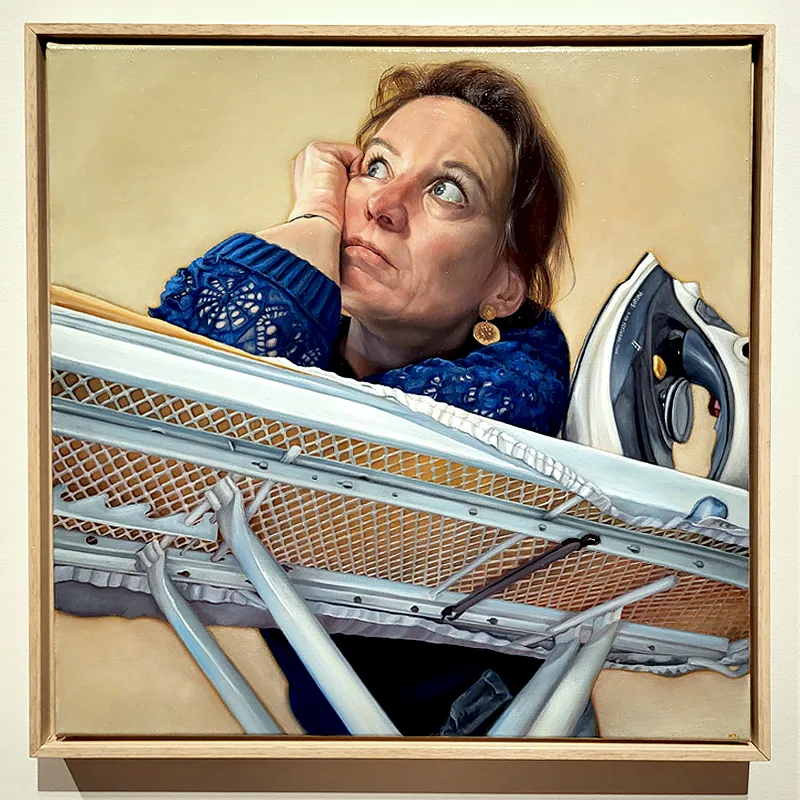
Useless, Part II by Karin Neijenhuis, oil on canvas, 2024
I wasn't necessarily looking for answers to any of these questions. For me, the interesting part was where the questions took my thoughts. One observation could open up another idea, which could lead somewhere else entirely.
By this point, one of those threads had become portraiture itself. How much does a portrait actually need to tell us what somebody looks like? The paintings I'd just been looking at seemed to suggest that likeness was only one part of it. Colour, surroundings, composition and even what the artist chose not to paint could all change the way I saw the person in front of me.
And the National Portrait Gallery is probably one of the best places to explore that thought because you only have to walk into another room to find yourself surrounded by portraits from a completely different time. Historically a portrait might have been commissioned to record someone's likeness, status or success. Before photography, a painting was one of the few ways of preserving what somebody looked like.
Perhaps that's why I found my reaction to some of the more traditional portraits so interesting. Considering I paint portraits myself, I probably should have been fascinated by rooms full of incredibly accomplished paintings of important people, but if I'm being completely honest, a lot of them left me a little cold.
Then I came across a portrait from a completely different period that took me back to Gabriel Choto's All You Need. Much of the canvas appeared almost untouched, yet the face had been painted in considerably more detail. I didn't know whether it had deliberately been left that way or whether, for whatever reason, it had simply never been finished, but perhaps that didn't matter. Surrounded by portraits where almost every part of the canvas had been carefully resolved, this was the one that stood out. Ironically, it was what wasn't there that made me want to look at it. Would I have found it as interesting if every inch of the canvas had been completed to the same level of detail?
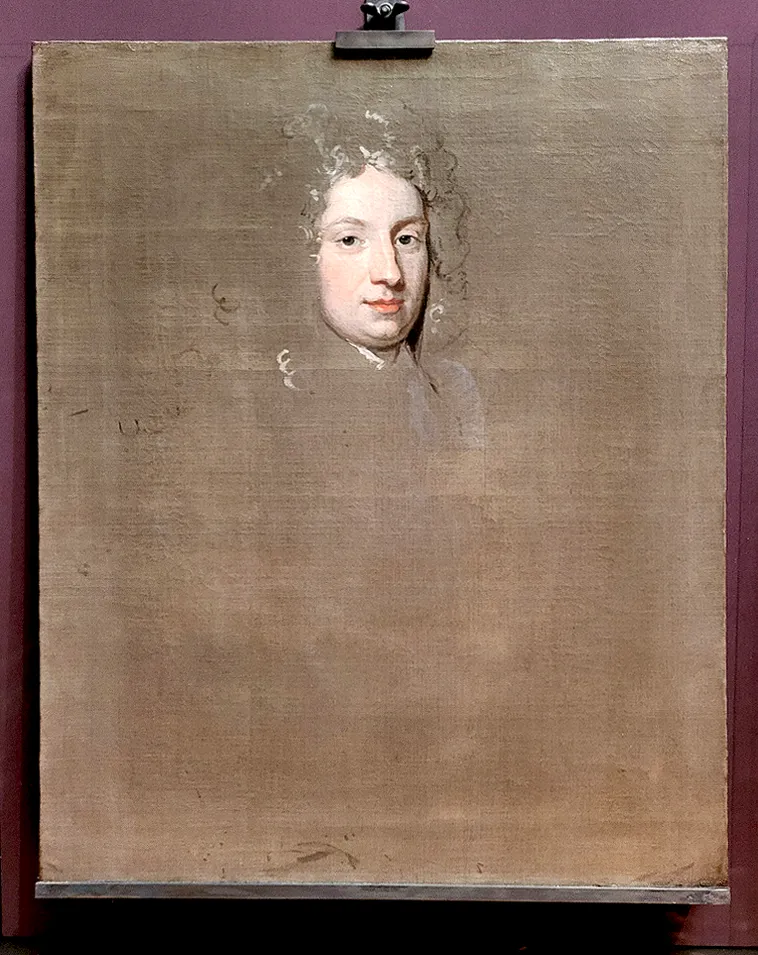
Richard Boyle, 2nd Viscount Shannon by Sir Godfrey Kneller, oil on canvas, 1710
In another room, David Hockney's self-portrait made me question something similar, but for a completely different reason. From a distance there was nothing particularly unusual about it, but up close I became fascinated by hands. One rested around the knee of the figure in the background while the other (Hockney’s hand) held a paintbrush, and neither seemed to make complete anatomical sense. The fingers reminded me slightly of those early AI-generated images where hands often seemed to contain a finger too many, or bend in ways fingers probably shouldn't.
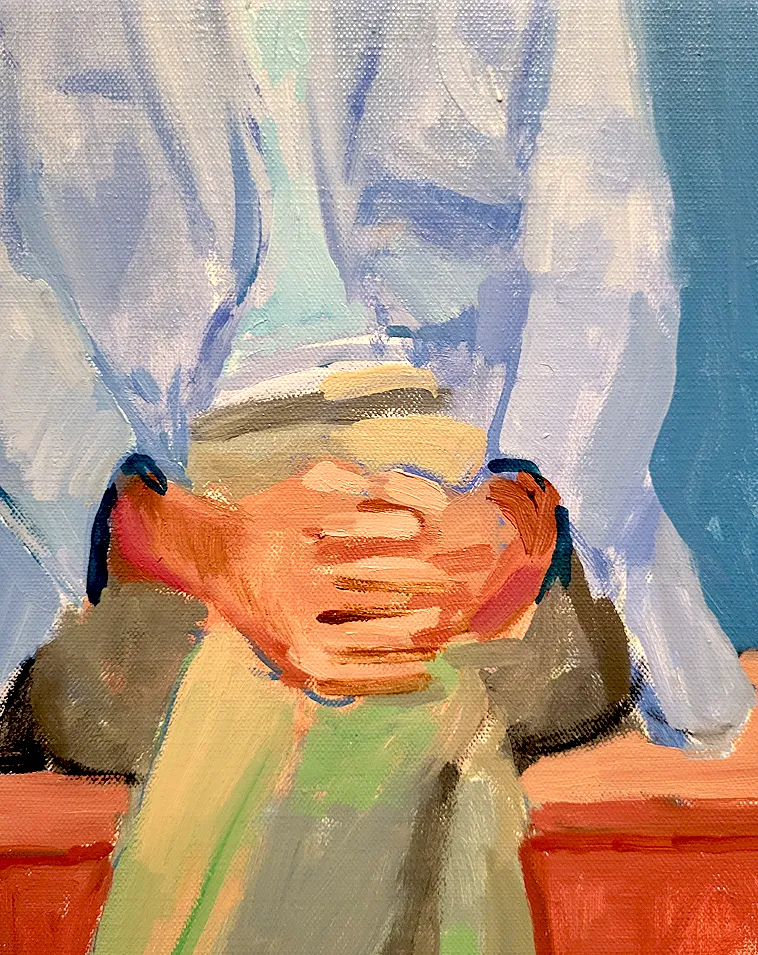
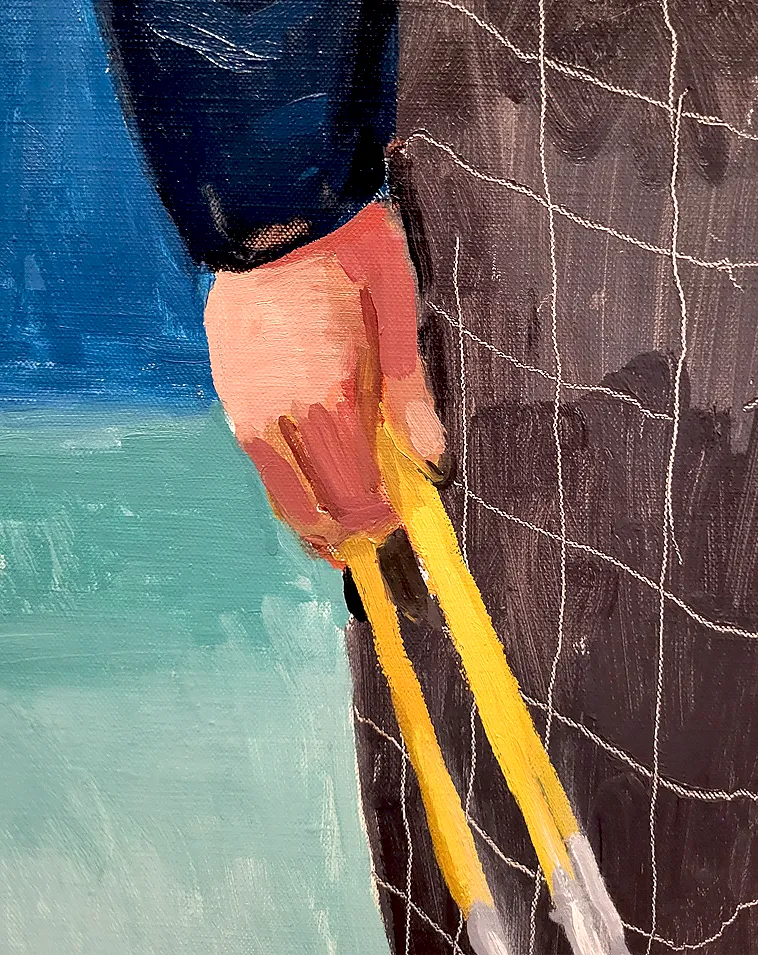
Details from a David Hockney self portrait showing his loose and simplified treatment of hands
Obviously, David Hockney knows how to paint a hand, which made the observation more interesting rather than less. Had he simply decided that those details didn't matter? Did making every finger anatomically perfect add anything important to the painting? Would I even have noticed them if I'd been standing a few feet further away?
Even the very idea of what counted as a portrait had started to feel much broader. One small display in the gallery called Everyday Portraits pushed that thought even further. Instead of paintings, it contained the portraits we encounter without necessarily thinking of them as portraiture at all: faces on banknotes, stamps, record covers, football stickers, clothing and memorabilia.
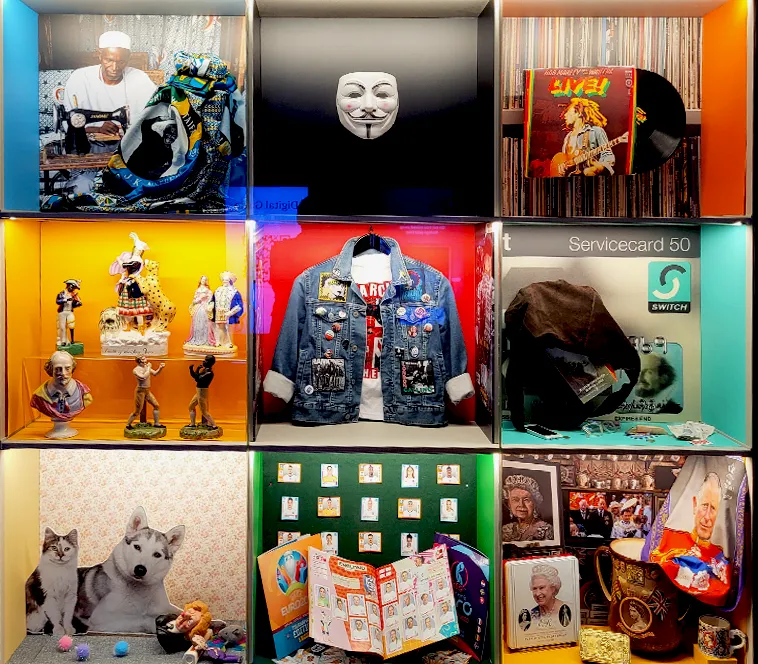
Everyday Portraits display at the National Portrait Gallery, exploring the many ways portraits appear in everyday life
I'd spent much of the gallery questioning what a painted portrait needed to show me, only to be reminded that portraits aren't confined to paintings in the first place. We carry them in our pockets, wear them on clothes, collect them, stick them in albums and sometimes barely notice they're there.
The questions didn't end when I left the gallery
Over a few beers with Axel and Anna from AntiKult Gallery, the conversation moved from looking at other people's art to thinking about our own. Anna is also an artist and we ended up talking about something that I'm sure most artists experience at some point: doubt. The strange combination of believing in what you're doing while simultaneously wondering whether you're doing any of it right.
We talked about other artists too, including Conor Harrington, whose work we both admire. There was a time when looking at an artist I respected that much could easily lead to thoughts about how I might create something similar. During that conversation I realised just how much that has changed.
I can admire the movement in his paintings, the atmosphere, the way he uses empty space or the confidence of a particular mark without wanting to create a Conor Harrington painting myself. Instead of simply thinking I want to do that, I can question what it is about those decisions that interests me and perhaps learn something from them, but whatever comes out the other side still needs to look like me.
That feels like quite a significant change. Admiration no longer needs to lead towards imitation. I can simply respect another artist's decisions while becoming more confident in making my own.
At some point I found myself saying to Anna, “I don't want to create a second-rate Conor Harrington. I want to create a first-rate Paul Kneen.”
Later that evening, a completely different conversation about Tracey Emin gave me perhaps the clearest example of how much my own thinking has changed. My brother-in-law said he didn't really understand her work and questioned her artistic ability. Once upon a time, I'd probably have agreed with him. This time I found myself defending her.
That doesn't mean I've suddenly become a huge Tracey Emin fan or that I'd want everything she makes hanging on my wall. What has changed is the question I'm asking. Rather than stopping at whether I like the work, I'm much more interested in what she's trying to do with it.
If the test for good art is whether you'd like it hanging above your sofa, a lot of Emin's work probably fails. But what if that's completely the wrong test? If much of her work is closer to a raw visual diary of her life, relationships and experiences, then judging it by how decorative it is makes about as much sense as judging a horror film by how funny it is.
I can still decide that I don't like something, but understanding it gives me more to base that opinion on. And sometimes, as happened with Emin, the opinion itself changes.
Thinking about the day afterwards, I realised there may have been another reason I'd asked so many questions. I was on my own. Most galleries I've visited have been with friends or family, whereas this time there was nobody waiting for me to move onto the next painting. If something caught my attention, I could stand there and let my thoughts wander for as long as I wanted.
Maybe that simply gave me the time to notice something that had been happening for a long time. I haven't stopped having opinions and I certainly haven't become incapable of deciding whether I like something. I've just become much less interested in treating that first reaction as the end of the conversation.
Perhaps that's where the growth I always hope for as an artist comes in. Not in knowing more or believing my opinions are somehow better than they used to be, but in being more willing to explore them. I can think one thing today and something completely different in five years' time because everything I experience between now and then has the potential to change the way I see it.
The interesting thing about asking questions is that you rarely know where they're going to take you. One might change an opinion you've held for twenty years. Another might make you look differently at your own paintings. Some might lead nowhere at all.
But by pulling on a thread you might find something at the other end that you weren't looking for. And perhaps that's the point. You don't always need to know what you're looking for before you start looking.
Maybe the trick is simply to start pulling.
Related Articles
What Makes Good Art?
Exploring how skill, taste, context, reputation and personal experience shape the way we judge art.
Can Your Art Be Recognisable Without Being Repetitive?
My thoughts on developing a recognisable artistic voice without feeling trapped by a signature style.
The Royal Society of Portrait Painters Annual Exhibition 2026
A reflection on portraiture, tradition and why the human face continues to hold attention.
Why I Didn’t Write a Tribute to David Hockney
Attention, legacy and the difference between being noticed and being remembered.
Priority Studio Access
I share new paintings, limited edition prints, exhibition news, articles and upcoming projects with subscribers first.
Get updates direct from my studio →
I’m a UK contemporary abstract portrait artist exploring inner noise, quiet pressure and the emotional complexity of modern life through fragmented portraiture and bold colour. I create original paintings and limited edition prints, while also writing about art, exhibitions and the realities of being an artist today. I also share work in progress and life in the studio on Instagram @paulkneenart.



 No spam. Unsubscribe anytime.
