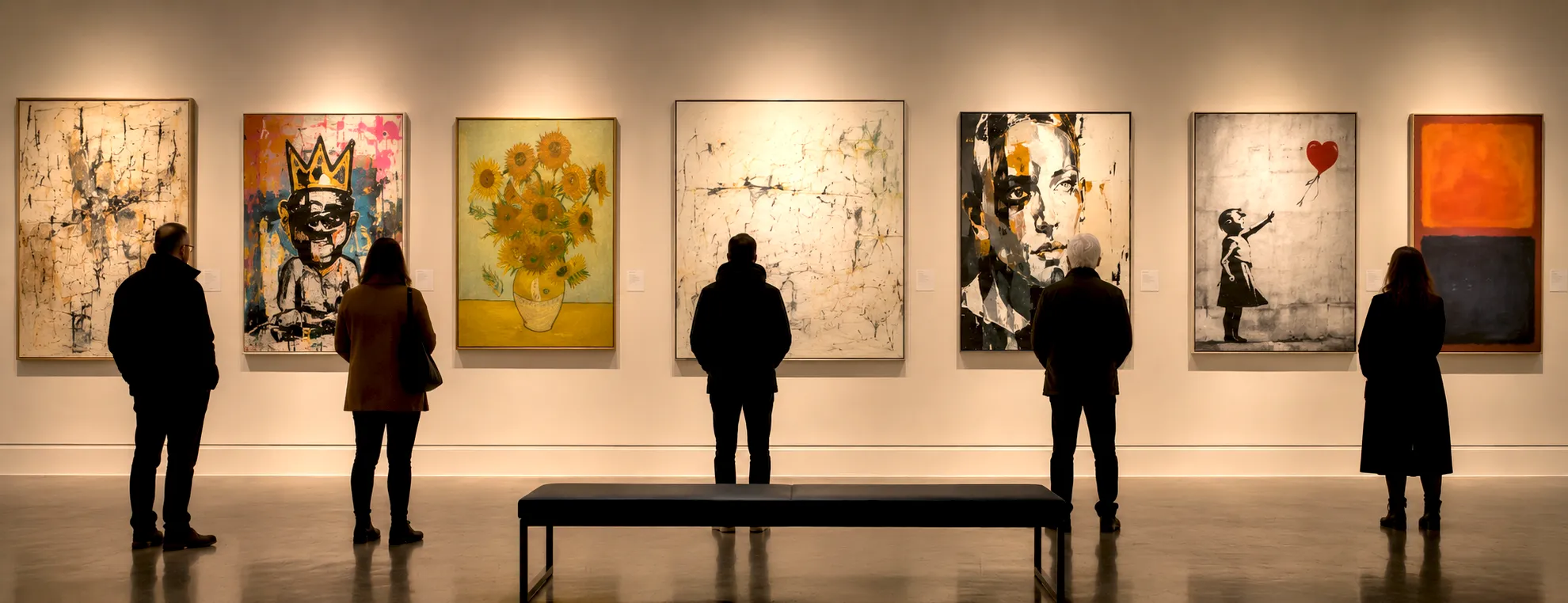
Recently, I visited an exhibition where several paintings had received awards. Looking around the room, I found myself agreeing with some of the decisions and questioning others. There were works I would have chosen that received no recognition at all.
The experience highlighted a question that artists, collectors, critics and gallery visitors have debated for generations...
What actually makes good art?
It sounds like a simple question, but the more you think about it, the more complicated it becomes. If good art were easy to identify, there would be far less disagreement about what belongs in galleries, what deserves praise and what will be remembered long after it was created.
The difficulty is that our relationship with art is rarely straightforward. Most of us make a judgement within seconds of seeing a painting. We instinctively decide whether we like it, dislike it or feel indifferent towards it. Only afterwards do we begin to justify that reaction.
This raises an interesting possibility. If our first response to art is often emotional rather than analytical, how do we decide what makes something good?
Taste and Personal Preference
Part of the challenge is that people do not always agree on what they value.
Many people make sweeping statements about creative genres. Someone might say they dislike a particular style of music, art or poetry without exploring it in any depth. Yet broad categories often contain huge variations in quality, style and intent.
Within music, for example, one person might dismiss Country as a genre, while another might love it. Neither response is necessarily right or wrong. They simply reflect different tastes.
The same thing happens in art. A painting that one person finds moving may leave another completely cold. An artwork that feels profound to one viewer may seem confusing or uninteresting to someone else.
If our reactions are so different, can personal preference really be the measure of good art?
Is Popularity Enough?
One possible answer is popularity.
After all, if millions of people admire a particular artist or artwork, there must be something appealing about it. Popularity can be difficult to ignore because it suggests that a work has connected with a large audience.
Yet popularity may only be part of the story.
Many bestselling books receive little critical acclaim. Popular films are often dismissed by critics, while critically celebrated films sometimes struggle to find a large audience. The same tension exists in the art world.
Popularity may tell us that something resonates with people, but it does not necessarily explain why.
The Influence of Gatekeepers
Historically, the art world has not been shaped by popularity alone.
For centuries, galleries, museums, critics, curators and collectors played a significant role in determining which artists received attention and which were forgotten. Their decisions helped shape artistic reputations and, in many cases, influenced how future generations viewed particular works.
Today, social media has made it easier for artists to reach audiences directly. An artist no longer needs a gallery exhibition to gain visibility. Yet the influence of institutions has not disappeared entirely.
This raises another question. If popularity is not enough, and expert approval is not enough, where exactly does artistic value come from?
The Role of Technical Skill
For many people, technical skill provides the answer.
Photorealist painters, for example, can produce images that appear almost indistinguishable from photographs. Their ability to control paint, light, colour and detail is often extraordinary.
For some viewers, that level of craftsmanship is enough to justify admiration. The skill involved is obvious, measurable and difficult to dispute.
Others admire the achievement but find themselves looking for something beyond technical accuracy. They may appreciate the skill while still feeling emotionally disconnected from the work.
If technical excellence alone cannot guarantee a powerful response, perhaps there is something else at work.
Does Effort Matter?
Photorealism also raises another interesting question.
Many of these paintings require hundreds or even thousands of hours to complete. But does the amount of time invested in a work automatically make it better?
Most people respect dedication. We tend to admire persistence, patience and effort. Yet effort alone rarely determines quality.
A painting that took a thousand hours to complete is not automatically better than one completed in a hundred. Time may contribute to value, but it does not provide a complete explanation.
Which brings us to a more challenging example.
The Cy Twombly Problem
Cy Twombly's work has sold for millions and hangs in some of the world's most respected museums. Yet his paintings divide opinion in a way that few photorealist works do.
Some viewers see energy, poetry and emotional expression within his marks. Others see little more than scribbles on a canvas.
What makes Twombly particularly interesting is that both reactions can occur while looking at exactly the same painting.
If technical skill, effort and popularity were enough to determine artistic quality, disagreements of this scale would be far less common.
So if the same paintings can inspire admiration in some people and bewilderment in others, what exactly are we measuring when we decide whether something is good?
Different Ways of Judging Art
Part of the answer may lie in the fact that people judge art according to different criteria.
Some viewers prioritise technical skill. Others value ideas. Some respond to emotion, while others are interested in history, symbolism or cultural significance.
None of these approaches is necessarily wrong. They simply focus on different aspects of what an artwork can offer.
The difficulty is that people often assume everyone else is using the same criteria they are.
In reality, two viewers can stand in front of the same painting and be evaluating entirely different things.
How Much Does Context Matter?
Questions like this force us to consider how much of our judgement is based on the artwork itself and how much is influenced by everything surrounding it.
Imagine that Vincent van Gogh painted Sunflowers today and nobody knew who he was. The painting appears online under a random username and receives little attention. Would we still consider it a masterpiece?
Perhaps we would. Perhaps we would not.
The point is not to question Van Gogh's talent. Rather, it is to ask how much reputation, history and cultural significance influence the way we experience art.
When we look at Sunflowers today, we are not seeing it in isolation. We are seeing it through more than a century of exhibitions, books, documentaries, scholarship and cultural admiration.
Whether we realise it or not, we never judge art in a vacuum. The stories, reputations and cultural narratives surrounding an artwork often become part of the experience itself.
The Banksy Effect
After all, the institutions, critics and cultural gatekeepers that helped establish artists such as Van Gogh within the art historical canon continue to shape perceptions of value today.
Banksy provides an interesting modern example. Few would deny his cultural impact, yet his success also raises an uncomfortable possibility. How much of his appeal comes from the artwork itself, and how much comes from the media attention, institutional recognition and market demand that now surround it?
Are people collecting the work because they genuinely love it, or because they are buying into a cultural phenomenon? If the same image had never been exhibited by major institutions, discussed in newspapers or sold through prestigious auction houses, would it be viewed in the same way?
It is an uncomfortable idea because it suggests that media attention, market value, cultural relevance and institutional support may influence our judgement far more than we would like to admit.
Why There Is No Magic Formula
The problem may be that we keep searching for a magic formula. A single quality that separates good art from bad art. But every explanation seems to break down under closer inspection.
Popularity alone cannot explain it. Technical skill alone cannot explain it. Time, effort, reputation and market value all influence our perceptions, but none of them provide a complete answer.
Art may not be judged according to a single criterion. When we encounter a painting, we rarely evaluate just one thing. We respond to a mixture of factors: skill, originality, emotion, context, reputation, personal experience and countless other influences that are difficult to separate from one another.
The challenge is that we do not all value these factors equally. Some people place great importance on technical skill, while others are drawn to emotional depth, originality or cultural significance. Even when looking at the same artwork, two people may be judging it according to entirely different priorities.
Is Beauty in the Eye of the Beholder?
Which brings us to a familiar phrase: beauty is in the eye of the beholder.
While that may sound like a cliché, there is probably some truth in it. Not because all art is equal, nor because quality does not exist, but because every viewer brings their own experiences, values and expectations to what they are looking at.
Good art may not be defined by any single quality. Instead, it emerges from a complex relationship between the artwork and the person experiencing it.
That may be why, centuries later, we are still asking the same question.
What makes good art?
Related Articles
Why I Leave Room for You in My Abstract Portraits
Why leaving space for the viewer can make a painting feel more personal, open and alive.
Can Abstract Portraits Feel More Real Than Realism?
Exploring how abstraction can sometimes reveal more emotional truth than visual accuracy.
When Art Competitions Become Popularity Contests
Questioning what happens when visibility, audience size and artistic merit become tangled together.
Fame, Art & Authenticity: Robbie Williams and the Rise of Celebrity Artists
How fame, identity and public perception can influence the way we judge art.
Priority Studio Access
I share new paintings, limited edition prints, exhibition news, articles and upcoming projects with subscribers first.
Get updates direct from my studio →
About Paul Kneen
I’m a UK contemporary abstract portrait artist exploring inner noise, quiet pressure and the emotional complexity of modern life through fragmented portraiture and bold colour. I create original paintings and limited edition prints, while also writing about art, exhibitions and the realities of being an artist today. I also share work in progress and life in the studio on Instagram @paulkneenart.



 No spam. Unsubscribe anytime.
