Recently, after hearing of David Hockney's passing, I found myself considering whether to write an article about him.
Yet despite admiring his work for years, I had never felt compelled to write about him before.
It took his death for the idea to occur to me.
Why?
Was I considering writing about David Hockney because I genuinely had something meaningful to say about an artist I admired?
Or was I considering writing about him because suddenly everyone else?
That question felt particularly relevant because a few weeks earlier, I'd written an article about Jake Wood and AI-generated art that had shown me just how quickly attention can gather around a particular story.
If I'm honest, part of me wondered whether I was wanting to do this for the latter reason. There is nothing unusual or ethically wrong about wanting your work to be seen, but I didn't want to write something simply for the sake of chasing views.
By the time I'd reached this conclusion, another thought occurred to me. What if everyone had already moved on from the news surrounding his passing anyway?
Curious to see whether my gut feeling was right, I opened Google Trends and looked at the search data surrounding Hockney's death.
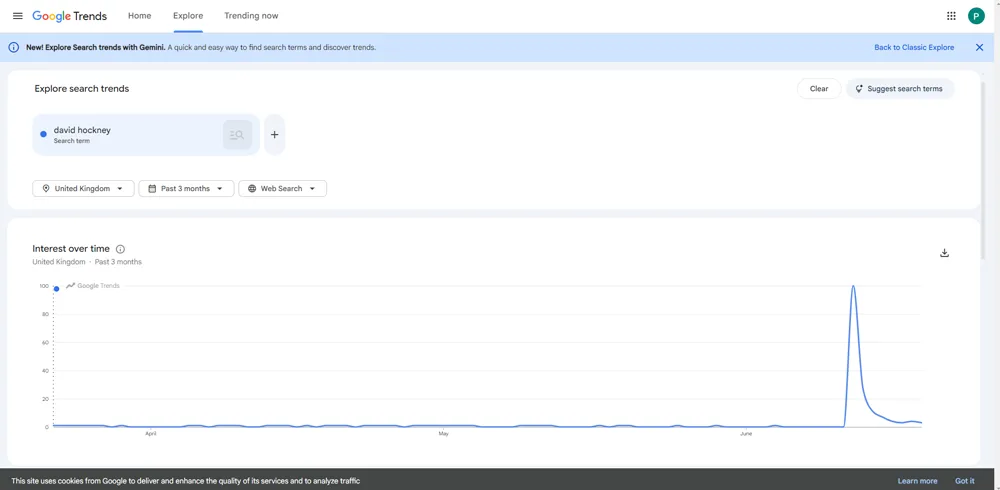
The graph showing a sharp spike in searches for David Hockney following news of his death before interest quickly declined
The graph did exactly what I suspected.
For a few days, huge numbers of people were searching for David Hockney.
Then they weren't.
Here was a world-famous artist's life condensed into a brief spike of interest.
Yet the graph didn't tell the full story. David Hockney didn't become one of Britain's most influential artists because he held people's attention for a few days. His reputation was built over decades of work, experimentation and persistence.
As I found myself questioning my own motives for wanting to write about Hockney, I noticed others doing something similar.
As soon as the news broke, sarcastic comments appeared online asking how long it would take for the first street art tribute to appear.
The more I read them, the more familiar they felt.
I had been questioning my own motives… they were questioning somebody else's.
Yet beneath both sat the same question:
What was the underlying motive?
Whenever a major story dominates the news cycle, how much of the response is driven by genuine admiration, and how much is driven simply by clicks and views?
Because, whether we like it or not, clicks and views carry real value which inevitably influences what people choose to create and share online, including artists.
As a result, the motives behind what we create become harder to untangle.
When Attention Becomes the Product
For years, I've seen videos involving paint being poured across canvases, artists performing elaborate stunts or creators making work in increasingly dramatic ways.
My initial reaction to these videos was often dismissive. The finished artwork frequently seemed secondary to the spectacle.
Then it occurred to me that I was looking at them in the wrong way.
Rather than judging the finished work, perhaps I should have been paying closer attention to what they were actually trying to achieve.
These creators weren't simply making art to sell in the traditional sense. They were building an entire business around attracting attention. The painting wasn't necessarily the product. The video was.
Once I saw that, I started noticing the same model everywhere. People clearing overgrown gardens for free because the video generates more value than the gardening itself. Mechanics documenting repairs because the audience is worth more than a day's labour. Creators restoring furniture, renovating abandoned buildings and transforming neglected spaces while millions of people watch online.
In each case, the attention surrounding the work has become valuable in its own right.
The internet has created a world where attention itself can be monetised. A viral video can generate advertising revenue, sponsorship deals and opportunities that far exceed the value of the thing featured in the video.
Attention can open a door, but if there is no significance behind it, people quickly move on.
Perhaps that's what makes significance so difficult to earn. Attention can be won in a moment, but creating something that endures is a very different challenge.
Creating Something That Endures
Recently, I joked about putting a £1 million price tag on a painting. Not because I seriously expect anyone to pay it, but because the idea raises an interesting question.
In a world where attention has become so valuable, how much of an artist's job is creating the work, and how much is getting people to notice it?
Would I like one of my paintings, articles or videos to go viral?
Of course I would.
Who wouldn't?
Decades ago, Andy Warhol famously suggested that in the future everyone would be world-famous for fifteen minutes.
Looking around today, it sometimes feels as though millions of people are chasing exactly that.
The more I thought about it, the more I realised there is nothing inherently shallow about going viral. For some people, a viral moment becomes the springboard for an entire career. The attention may arrive overnight, but turning that attention into something lasting still requires years of work.
And perhaps that's the real challenge.
Getting noticed is one thing. Giving people a reason to come back is something else entirely.
Over the last year I've spent a great deal of time building a website, writing articles and creating new work. Not because I believe slow growth is somehow more noble than a viral breakthrough, but because whatever form attention takes, it still needs something meaningful to land on.
Attention matters. Artists need to be seen, and a painting cannot be appreciated if nobody discovers it.
But attention and significance are not the same thing.
One can happen overnight.
The other, like Hockney's legacy, is built over years.
Related Articles
What the Jake Wood AI Art Controversy Really Says About Art Today
A closer look at AI, authorship and what we believe gives artwork its value.
When Art Competitions Become Popularity Contests
Questioning what happens when visibility, audience size and artistic merit become tangled together.
Fame, Art & Authenticity: Robbie Williams and the Rise of Celebrity Artists
My thoughts on how fame, identity and public perception can influence the way we judge art.
Social Media for Artists: A Double-Edged Brush in a Content-Driven World
Exploring the uneasy relationship between visibility, creativity and constant online output.
Priority Studio Access
I share new paintings, limited edition prints, exhibition news, articles and upcoming projects with subscribers first.
Get updates direct from my studio →
About Paul Kneen
I’m a UK contemporary abstract portrait artist exploring inner noise, quiet pressure and the emotional complexity of modern life through fragmented portraiture and bold colour. I create original paintings and limited edition prints, while also writing about art, exhibitions and the realities of being an artist today. I also share work in progress and life in the studio on Instagram @paulkneenart.


 No spam. Unsubscribe anytime.
