Originally published 15 May 2026 | Updated 18 May 2026
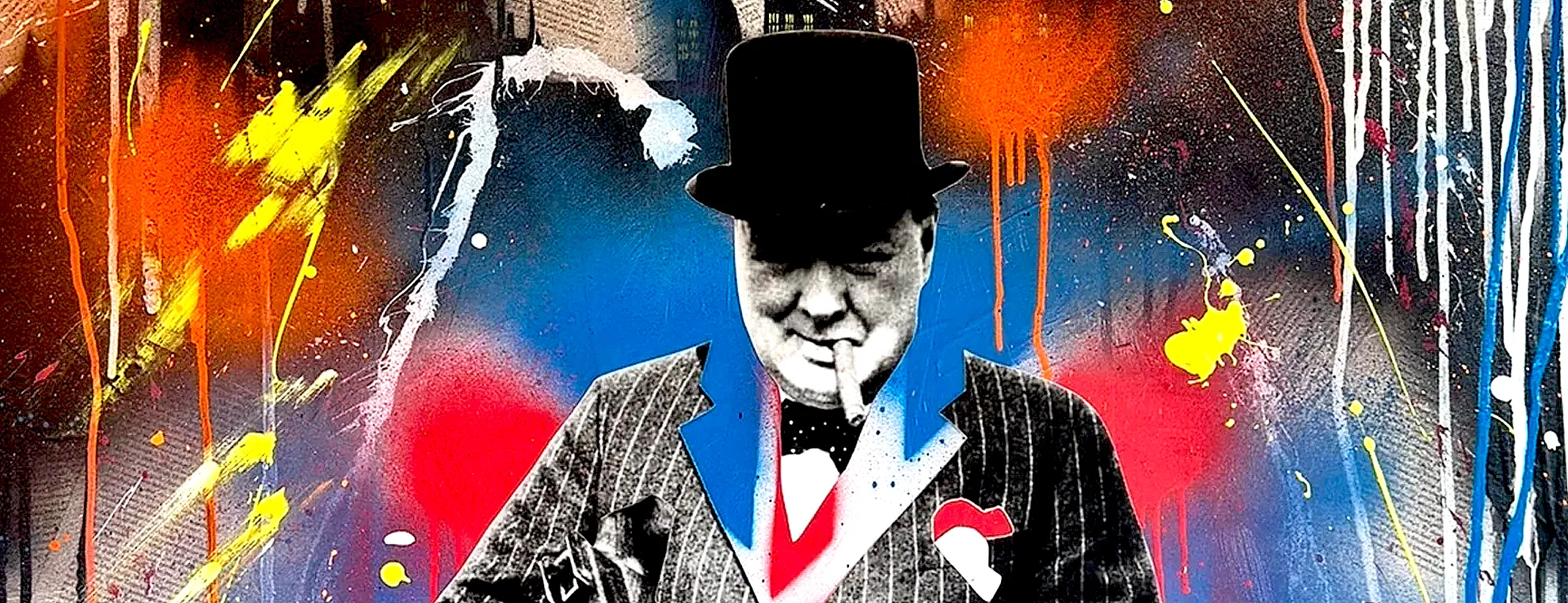
When actor Jake Wood recently launched a solo art exhibition in Brighton, it quickly became the focus of an online debate. At first, the conversation seemed familiar enough: another well-known figure stepping into the art world and provoking mixed reactions. But the criticism soon shifted in a different direction after people began questioning whether some of the work incorporated AI-generated imagery.
As the discussion intensified, Wood responded publicly, explaining that while he had not personally generated AI images himself, some source material used within the work had come from imagery found online that contained AI elements. He also openly described himself as being early in his artistic journey and still experimenting.
That honesty matters.
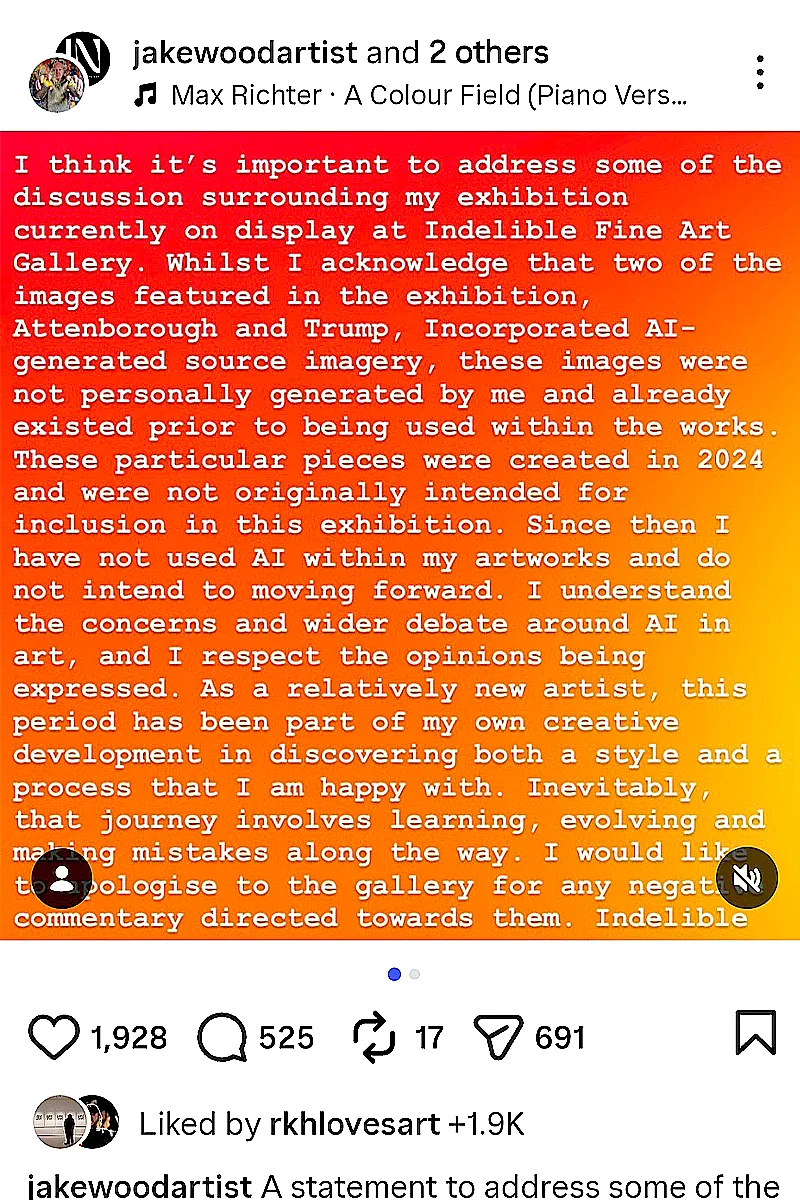
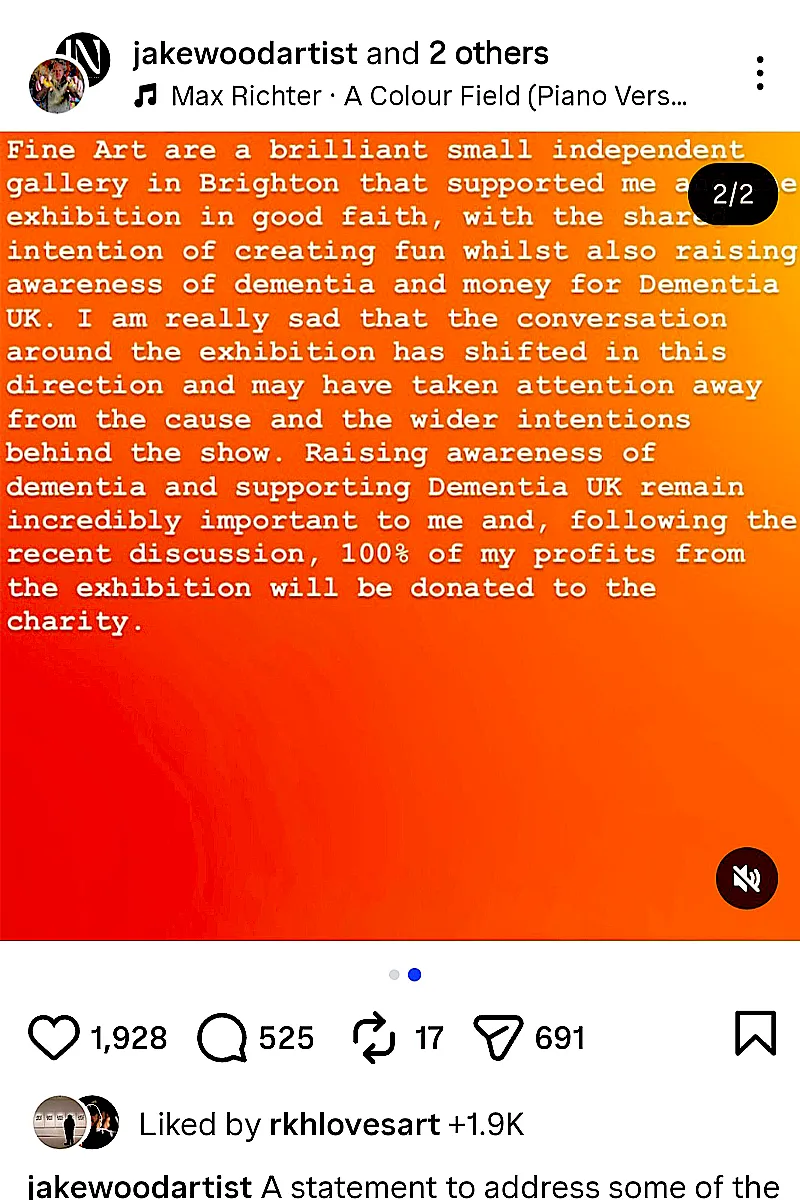
Jake Wood’s public Instagram statement responding to criticism surrounding his Brighton exhibition.
Screenshots: Instagram/@jakewoodartist
Because while social media tends to favour outrage and quick conclusions, this situation feels far more complicated than a simple case of right or wrong. The more I followed the conversation, the more it seemed to expose something much bigger: a growing uncertainty around authorship, effort, authenticity and what we now expect art to be.
Update: The Exhibition Has Since Closed Early
Since this article was first published, Jake Wood’s exhibition has reportedly closed earlier than planned following continued backlash surrounding the use of AI imagery and criticism online.
According to reports, the situation escalated beyond debate around the artwork itself, with abusive messages allegedly directed towards the gallery. Wood had already publicly apologised, clarified aspects of the creative process and stated he no longer intends to use AI within future work.
If anything, this development makes the questions surrounding authorship, authenticity and public reaction feel even more relevant. What began as a debate about AI in art now appears to raise another uncomfortable question:
At what point does criticism stop being constructive and become something else entirely?
At the centre of the backlash sits a question that feels increasingly difficult to ignore:
What exactly counts as making art in 2026?
When Does Inspiration Become Something Else?
Artists have always borrowed.
Painters work from photographs, musicians sample older songs and entire artistic movements have emerged through reinterpretation and appropriation. In many ways, creativity has always involved absorbing ideas, reshaping influences and building upon what came before.
Yet AI seems to provoke a different emotional reaction.
Part of that may be because many people still connect art with labour. Not simply technical skill, but effort — the years spent experimenting, failing, refining ideas and gradually developing a visual language that feels personal.
This is something I explored in a previous article about AI and creativity because, if I am honest, I suspect many of us feel conflicted. AI is clearly becoming part of the creative landscape and pretending otherwise feels unrealistic. At the same time, there remains a strong desire for art to feel human, personal and somehow earned.
Perhaps that word — earned — sits underneath much of the reaction to this story.
Because what seemed to frustrate many artists online was not simply the involvement of AI itself, but the perception that the process had become blurred.
If imagery has been sourced online, adapted and transformed, where exactly does authorship begin? Is selecting and arranging visual material enough to claim ownership? Or does artistic value still sit partly in what has been physically made?
These are not entirely new questions. What feels new is the speed at which technology is forcing us to confront them.
What Does It Mean To Actually “Make” Art?
One detail of the story that particularly caught my attention was the involvement of a mural company recreating one of Wood’s paintings on the outside of the gallery building.
My initial reaction, if I am honest, was probably similar to many artists:
Does money now allow ideas to replace skill?
It is an uncomfortable question, particularly for people who spend years learning techniques, making mistakes and physically building a body of work. Yet after sitting with that thought for a while, it became clear that the answer is not nearly as straightforward as it first appears.
Because contemporary art has challenged traditional ideas of authorship for decades.
Andy Warhol had The Factory, where assistants helped produce work. Damien Hirst frequently works with studio fabrication. Jeff Koons employs teams of highly skilled fabricators to physically realise his ideas.
Even historically, many artists worked with assistants.
The idea that artists must personally create every brushstroke or physical element of a work has never been entirely true.
Which perhaps shifts the question slightly.
Maybe this debate is less about whether artists physically make everything themselves and more about where audiences draw the line between authorship and outsourcing.
If someone else paints the mural but the idea belongs to the artist, is it still their work?
If technology contributes to imagery, does authorship become diluted?
And if an artist acts more like a director than a maker, does that change how we value the work?
A quote often linked to Banksy says:
“Art is whatever you can get away with.”
It is provocative, slightly cynical and intentionally uncomfortable. Yet moments like this make me wonder whether the bigger question today is not simply what artists can get away with, but what audiences are willing to accept once the process becomes visible.
Is The Real Issue Actually Authenticity?
AI alone does not fully explain why people reacted so strongly.
What seems to sit underneath much of the criticism is something harder to define: authenticity.
Or perhaps more specifically, a perception around effort, artistic development and whether the work had fully earned the platform it had been given.
That is difficult territory because art has never followed a neat set of rules. There is no official point at which someone becomes “ready” for a solo exhibition. Artists develop at different speeds. Some arrive fully formed while others slowly evolve in public.
Wood himself described being early in his artistic journey and still experimenting. There is nothing wrong with that. Experimentation is essential. Most artists spend years trying ideas that fail, borrowing influences, changing direction and gradually figuring out what they actually want to say.
Speaking personally, much of my own work has emerged through exactly that kind of slow development. Paintings often begin with uncertainty, evolve through experimentation and occasionally fail completely before something starts to click. That slower process of trial, error and refinement still shapes the way I approach my own original paintings today.
Perhaps that is partly why I can understand why some artists reacted emotionally to this situation.
The frustration, from what I observed, seemed less about celebrity itself and more about a perception that both the opportunity and the making had become unusually accelerated.
After all, most artists understand hard work. Jake Wood has clearly worked hard to build a successful acting career. Few people would dispute that.
But artistic practice is its own journey.
And for many artists watching from the outside, the uncomfortable feeling seemed to be this:
Had the slower process of developing an artistic voice somehow been bypassed?
That may not be entirely fair. But it feels important to acknowledge because it speaks to something many artists quietly wrestle with.
When Fame Enters The Conversation
Of course, celebrity inevitably complicates all of this.
I wrote previously about celebrities entering the art world and why reactions can be so mixed. Fame changes visibility. Existing audiences create opportunities that most emerging artists simply do not have access to.
That does not automatically invalidate the work.
But it undeniably shapes perception.
Take Robbie Williams, whose recent exhibition felt closely tied to his own experiences with anxiety, vulnerability and mental health. Whether people connected with the work or not, there appeared to be a clear sense of personal reflection behind it.
The conversation surrounding Jake Wood feels different, perhaps because the work appears closer to experimentation and visual borrowing while still in the process of discovering its own language.
Which naturally raises another uncomfortable question:
Would the same exhibition have happened if the artist behind it had been completely unknown?
Most people will probably already have their own answer.
Yet perhaps fame has always accelerated access. Connections, visibility and money have shaped artistic careers for generations. Social media may simply make those realities harder to ignore.
Maybe Transparency Matters More Than Technology
At the centre of much of this debate sits something surprisingly simple:
Honesty.
If audiences had known from the start exactly how imagery had been sourced or developed, would the reaction have felt different?
If experimentation had been openly framed as experimentation, would people have been more understanding?
Most people understand that artists borrow references, test ideas and evolve over time. Creative process is rarely neat.
What audiences often struggle with is ambiguity around authorship.
People want to understand what role the artist played, where technology entered the process and what genuinely belongs to the maker.
Perhaps audiences are not rejecting AI outright at all.
Perhaps what they are asking for is transparency.
Questions Without Easy Answers
What interests me most about this situation is that it resists simple conclusions. The longer the conversation unfolded, the less it felt like a story about one actor experimenting with art and the more it felt like a reflection of something much bigger.
Beneath the headlines sits a growing uncertainty around effort, originality, technology and what we now ask art to do for us.
Perhaps what makes conversations like this so complicated is that most of us are trying to hold several ideas at once. We want art to evolve, yet still feel human. We accept experimentation, but still value effort. We embrace new technology, while quietly hoping something personal and authentic remains at the centre of it.
The fact that the exhibition ultimately closed early only adds another layer of complexity. Healthy criticism matters, particularly when conversations around authorship and transparency feel increasingly important. Yet when artistic debate turns hostile, something more uncomfortable emerges. If artists stop experimenting for fear of public humiliation, we risk creating a culture where curiosity quietly disappears. That does not mean criticism should disappear — only that perhaps there is still a difference between accountability and punishment.
Maybe there are no clean answers.
Perhaps art has always existed somewhere inside that tension — between idea and execution, authenticity and performance, human instinct and whatever comes next.
Perhaps the real question is not whether art is changing... but whether we're still searching for the same things within it.
Related Articles
Why I Didn’t Write a Tribute to David Hockney
A reflection on attention, legacy and the difference between being noticed and being remembered.
When Art Competitions Become Popularity Contests
A look at what happens when visibility, audience size and artistic merit become tangled together.
Art vs Algorithms: What AI Art Means for Human Artists
My thoughts on creativity, technology and what may still make human art matter.
Fame, Art & Authenticity: Robbie Williams and the Rise of Celebrity Artists
Questioning how fame, identity and public perception influence the way we judge art.
Priority Studio Access
I share new paintings, limited edition prints, exhibition news, articles and upcoming projects with subscribers first.
Get updates direct from my studio →
About Paul Kneen
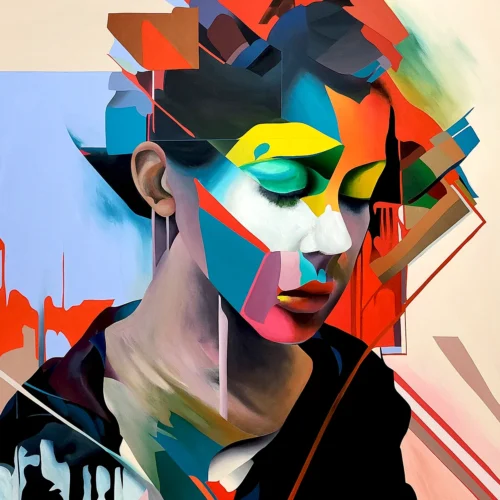
I’m a UK contemporary abstract portrait artist exploring inner noise, quiet pressure and the emotional complexity of modern life through fragmented portraiture and bold colour. I create original paintings and limited edition prints, while also writing about art, exhibitions and the realities of being an artist today. I also share work in progress and life in the studio on Instagram @paulkneenart.


 No spam. Unsubscribe anytime.
