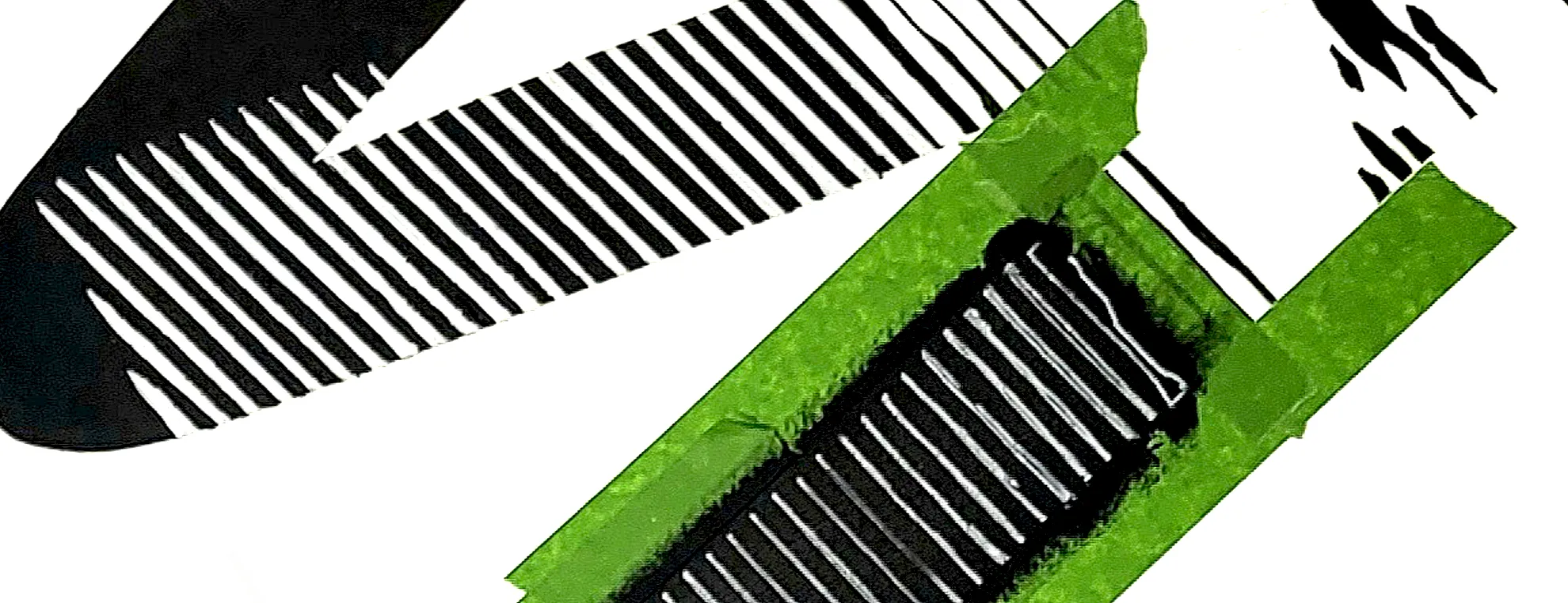
If an artist traces an image rather than drawing it freehand, some people consider that cheating. The same accusation can be levelled at projectors and other tools artists use to help transfer an image onto a canvas.
Which has always made me wonder: when it comes to cheating in art, is there a line?
There are now countless ways tools and technology can assist in making art, from helping to transfer an image onto a canvas to creating the initial idea itself. For some, the question might be how much assistance is too much. For others, perhaps using certain tools at all is already cheating.
I'm not convinced there is one answer. I'm not even convinced everyone is starting from the same idea of how an artist is supposed to work.
Does an Artist Need to Be Able to Draw Freehand?
Tracing seems to cross the line for some people because it bypasses the need to draw something freehand. But even that assumes drawing should be part of the process in the first place.
Being able to draw accurately seems to be a strange benchmark for whether somebody is considered a 'proper' artist. Which makes me wonder who decided that in the first place.
There are hugely successful artists whose practice doesn't require them to sit down with a pencil and accurately reproduce what they see. Their skill might lie in colour, composition, sculpture, abstraction, photography, materials or simply coming up with ideas. Some may rarely draw at all.
If an artist can't accurately draw a portrait freehand, does that make them less of an artist?
I don't think it does. But that makes the original question more complicated. If drawing ability isn't a requirement for being an artist, why would choosing to bypass drawing automatically be cheating?
Imagine seeing a painting in a gallery and loving it. You know nothing about the artist or their process; you simply respond to what's in front of you. Then you discover that the original drawing was traced or projected onto the canvas.
Nothing about the painting has changed, but has your opinion of it?
For some people, I'm sure it would. Part of what they value in a painting might be the physical skill involved in producing it. For somebody else, how the original image arrived on the canvas might be completely irrelevant.
Why I Use Tools in My Own Painting Process
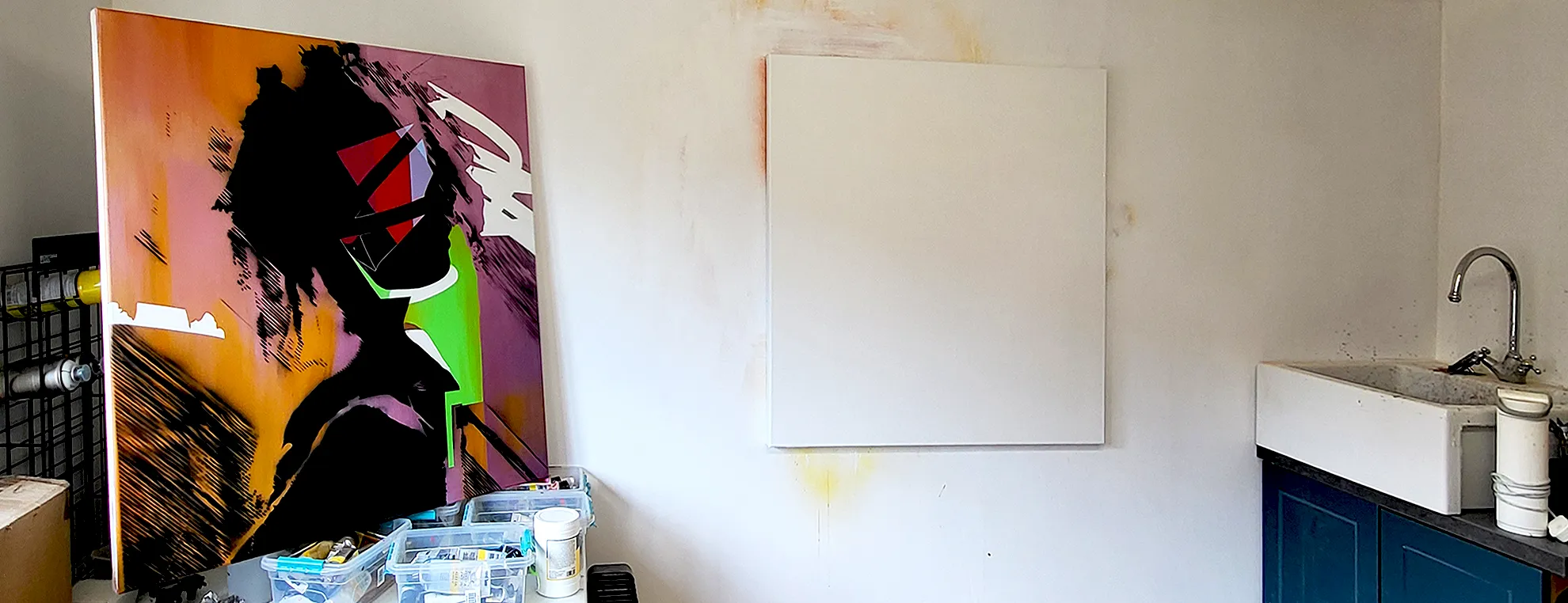
In my own work, I spend hours drawing, designing and moving things around digitally before I ever get near a canvas. By the time I'm standing in front of it, I have a pretty good idea of where I'm heading, and I'll use a mixture of freehand drawing, tools and technology to get that information onto the canvas.
I've already spent hours creating the composition, so I've never really understood why I need to spend more time reproducing exactly the same information freehand, especially if the only reason for doing so is because that's considered the 'proper' way to do it. If I can accurately complete that stage of the process in thirty minutes rather than several hours, have I cheated or have I simply saved myself some time?
As a full-time artist trying to make a living from what I create, saving that time isn't insignificant. Paint costs money, canvases cost money and so does the time spent creating them. There is a practical reality to making art that sometimes gets lost amongst the more romantic ideas of how an artist should work.
And ultimately, all I've saved is the time it takes to transfer the design. The painting still has to be made. The one I'm working on as I write this actually came about after I decided to start the previous version again. It was planned before I started, yet I've still made hundreds of decisions while painting it that weren't contained in the original design. Colours change, one decision affects another and ideas appear that weren't there at the beginning. A plan gives me somewhere to start; it doesn't necessarily tell me where I'm going to finish.
Artists Have Been Using Tools for Hundreds of Years
But if using a tool can be considered cheating, it raises another problem: artists have been using tools and devices to help create their work for hundreds of years. Grids, tracing methods and optical devices all existed long before Photoshop and digital projectors. The technology has changed, but the principle hasn't.
Today's artists simply have more options available. Lightboxes, projectors and digital software can all assist with transferring an image onto a canvas or wall.
But if we're trying to decide where cheating begins, perhaps the problem starts even earlier. Should an artist use any of these things at all? Should they draw the image freehand first? Or should a painter simply pick up a brush and go straight onto the canvas?
And if some assistance is acceptable, which bit changes things?
A grid? Tracing paper? A lightbox? A projector?
What about a stencil?
Are Stencils Cheating in Art?
Banksy is perhaps the most obvious example. The stencil isn't something hidden within his process; it's fundamental to it. It allows an image to be reproduced accurately and quickly - an obvious advantage when creating street art. Yet the fact that he isn't standing there drawing and painting every line freehand hasn't stopped him becoming one of the most recognisable artists in the world.
Even within stencil art, though, artists make very different choices about how much of the process they want to do themselves.
The artist duo SNIK create incredibly intricate multi-layered stencils which they cut by hand. Those same designs could potentially be machine-cut considerably faster, but hand-cutting remains an important part of their practice.
Another stencil artist might design exactly the same kind of image digitally and have a machine cut the stencil for them.
The end result in both cases is still an artist spraying paint through a stencil. So does cutting it by hand make one process more legitimate than the other?
Maybe it does.
If hand-cutting is an important part of SNIK's practice, removing it could arguably remove something from the work. But that doesn't necessarily mean another artist has to attach the same importance to that particular stage of the process.
The more difficult question becomes which parts an artist actually has to physically do themselves.
Do Artists Have to Physically Make Their Own Art?
Andy Warhol pushed that question considerably further. Photographic silkscreen printing, repetition and mechanical reproduction became fundamental to his work. The Factory was hardly based around the traditional image of one artist producing one unique object at an easel. Assistants were involved and the means of production became part of the work.
Interestingly, tracing itself was also part of Warhol's process. For some of his works, simple outlines from a photographic image were traced onto the canvas as guides for the underpainting before the final silkscreen image was printed on top.
Yet we don't generally dismiss a Warhol because Andy didn't draw and paint every element himself.
The same becomes even harder to argue when the artist doesn't make the work entirely themselves. Damien Hirst has famously used assistants to produce artworks under his direction, including many of his spot paintings. The idea, instructions and authorship remain associated with Hirst even when somebody else's hand applied the paint.
If tracing is cheating because the artist hasn't personally drawn every line, what happens when the artist hasn't personally painted every spot?
Perhaps the important thing is the idea rather than who executes it.
That seems like a reasonable answer until you look outside painting and realise we've been comfortable with that arrangement for centuries.
St Paul's Cathedral is inseparably associated with Sir Christopher Wren. Yet Wren didn't personally carve every piece of stone, build every wall and construct the cathedral with his own hands. He designed it, and a huge number of skilled people turned those designs into the building that exists today.
Nobody visits St Paul's and complains that Wren cheated because somebody else did the building.
Frank Lloyd Wright offers an even more interesting version. He worked alongside apprentices and draftsmen at Taliesin who helped develop architectural drawings and details from his designs. Wright could sketch an idea, while others within the studio helped turn those ideas into the drawings required to realise the building.
And yet we still call the result a Frank Lloyd Wright building.
Architecture obviously isn't painting. One person can make a painting, whereas it would be rather ambitious for one person to build St Paul's Cathedral. But we seem perfectly comfortable with the principle that somebody can conceive something, direct its development and have other people realise it while retaining authorship of the finished work.
If that's true, perhaps the original idea is the important bit. Maybe it doesn't matter whether you draw every line, cut every stencil or physically apply every drop of paint. If the idea came from you and you're directing how it's realised, perhaps that's enough.
Except even that isn't quite as simple as it sounds.
Does AI Change Where We Draw the Line?
I recently watched a video of a street artist painting a large mural who admitted he'd used AI to help create the original image before adapting it into his own style and painting it onto the wall. What stood out was that he seemed almost apologetic about it, as though he'd been caught doing something he shouldn't.
Interestingly, most of the comments underneath were supportive. The general feeling seemed to be that it didn't really matter how he'd arrived at the image because he still had to physically paint the thing onto a wall.
But if physically making the work isn't necessarily what determines authorship, that defence doesn't really solve anything. And if the important part is having the original idea, there's another problem: AI helped create that too.
There is clearly a difference between using a projector to transfer a composition you've already created and asking technology to generate the initial image for you. One assists with execution; the other potentially participates in creation.
Perhaps that's where the line should be.
But how much participation is too much? An artist writes the prompt, rejects results, chooses one, alters it, combines things, adapts it into their own visual language and decides how it becomes a physical artwork.
Does the amount of involvement matter? Does the quality of the idea matter? Does it matter whether they could have created the original image without AI?
Which brings us remarkably close to the question we were asking about tracing in the first place: does it matter whether the artist could have created the image without the tool?
I'm not suggesting tracing demonstrates the same drawing ability as creating something freehand, any more than generating an image using AI is the same as drawing it yourself. But perhaps that's not really the question.
The question is whether using either of those things means you've cheated.
And I'm still not sure I know the answer.
Every time there appears to be an obvious place to draw the line, another example seems to move it. Perhaps that's because there isn't one line at all. Maybe everyone - artists and viewers alike - has their own idea of which parts of the process matter and which don't.
So I'm not going to tell you whether tracing is cheating. I'd rather leave you with the same question.
Do you think tracing is cheating in art?
And if it is, where do you draw the line? (Sorry for the pun, I couldn't resist it 😊)
Related Articles
What the Jake Wood AI Art Controversy Really Says About Art Today
A closer look at AI, authorship and what we believe gives artwork its value.
What Makes Good Art?
Exploring how skill, taste, context, reputation and personal experience shape the way we judge art.
Why I Still Use Masking Tape in My Paintings
Discover how the process behind my paintings became connected to the ideas they explore.
Acrylic Paint vs Oil Paint: Why I Choose Speed, Versatility, and Innovation
Why acrylic paint suits the pace, layering and structure of my abstract portrait paintings.
Priority Studio Access
I share new paintings, limited edition prints, exhibition news, articles and upcoming projects with subscribers first.
Get updates direct from my studio →
I’m a UK contemporary abstract portrait artist exploring inner noise, quiet pressure and the emotional complexity of modern life through fragmented portraiture and bold colour. I create original paintings and limited edition prints, while also writing about art, exhibitions and the realities of being an artist today. I also share work in progress and life in the studio on Instagram @paulkneenart.


 No spam. Unsubscribe anytime.
