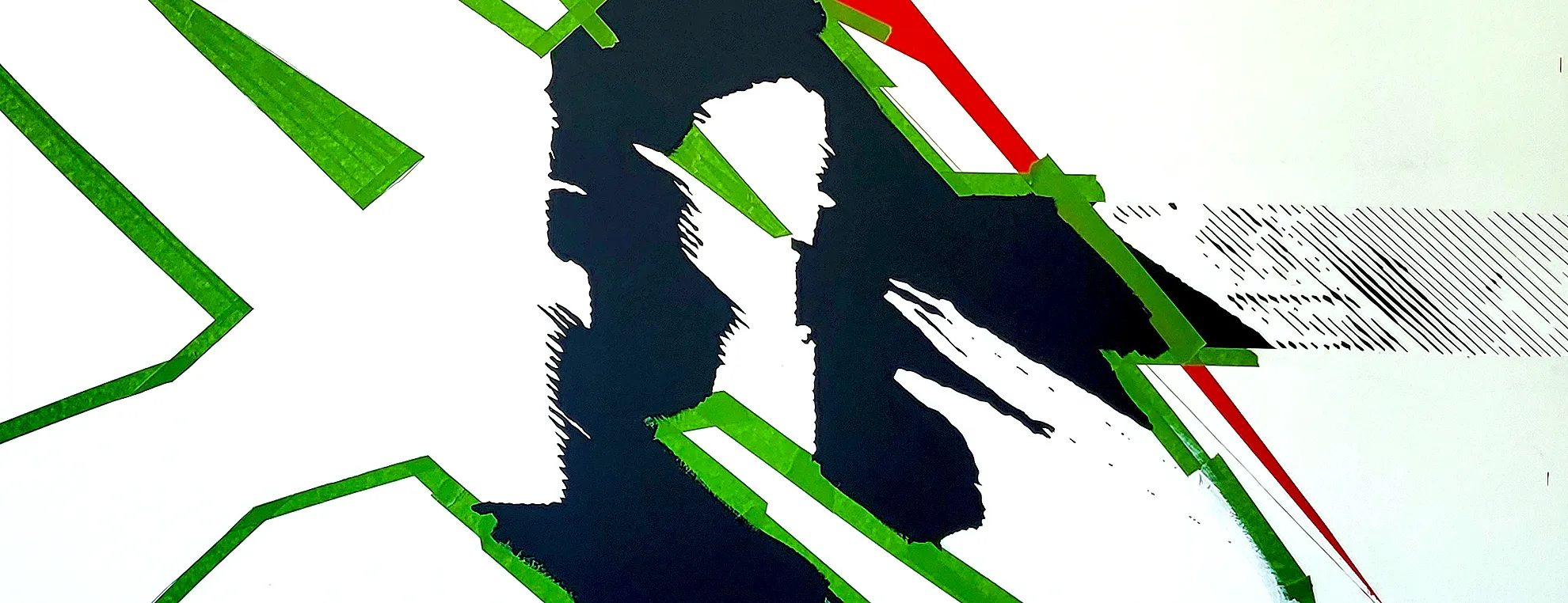
Since agreeing a solo show in Hamburg for the beginning of April next year, I've found myself even more focused on the time I spend in the studio. Earlier this year a lot of my attention had been going into my newly revamped website and everything that came with it. I was still painting, but I was also spending a considerable amount of time writing articles, working on the website and trying to build the other side of my career.
Hamburg has shifted that balance firmly back towards painting and, perhaps as a result of spending so much time thinking about the work, I've stumbled onto an idea that's really excited me. I've started introducing hand-painted halftone stencil elements that weave in and out of the paintings, and it feels as though the work has moved forward again. Inevitably, that's only made me want to spend even more time in the studio seeing where it goes.
Perhaps that's why I've found it interesting that recently I've had the words work-life balance thrown at me by various family members and close friends. It has made me wonder what work-life balance actually looks like when your work is also something you genuinely want to spend most of your time doing. For a lot of people there is quite a clear distinction between work and everything else. They get up on Monday morning, huff and puff about having to go back to work and keep huffing and puffing until 5pm on Friday. Obviously I'm generalising, but you get the point.
When Your Work Is Something You Actually Want to Do
I don't really have that. I genuinely get excited about going into the studio. I want to see how the latest painting develops. If I've had an idea the night before, I want to try it. If something isn't working, I want to work out why. More often than not, I feel as though I'm being dragged away from the studio by something else rather than dragging myself into it.
Even writing this article is a good example. I've made a commitment to myself to write an article every week and I know why I do it. Only yesterday, someone contacted me on Instagram to tell me they'd found one of my articles via Google AI. They then read some of my other articles, looked at my work and eventually found me on Instagram. That's pretty good evidence that sitting here writing this isn't a waste of time, yet a sizeable part of my brain is currently telling me I should be in the studio.
The exhibition isn't until April 2027, which sounds like plenty of time but my brain doesn't see it that way. It sees a finite number of months, which become weeks, which become potential studio days. Before long I'm calculating how long each painting might take and therefore how many paintings I could realistically produce.
Taking a day off sounds perfectly reasonable until part of my brain points out that it's one less day of painting. What happens if I get to March and feel as though I'm running out of time? Will I look back at those days and think about what I could have achieved with them?
My goal is to get ahead of the curve because the last thing I want is to arrive at the deadline feeling as though I've run out of time. I don't want to send ‘that’ll do’ paintings to Hamburg. I want to stand in the gallery, look at the work on the walls and know that every painting is there because I'm proud of it.
The Pressure of Preparing for a Solo Exhibition
I'm not sure whether that's particularly healthy, but it is how I feel. The strange thing is that I'm enjoying the pressure. I've set a high bar for the work because I think having that bar makes me better, and this time it isn't only my own expectations I'm thinking about. AntiKult Gallery have given me the opportunity to have a solo exhibition and I want them to be proud of what eventually arrives in Hamburg. I don't just want to meet their expectations; I want to exceed them.
That doesn't mean rushing paintings to meet some imaginary production schedule I've created in my head. One of the paintings I'm currently working on has already taken longer than I expected. I thought it would be finished by now, but I know it isn't, so rather than force it to a conclusion because I've mentally allocated it a certain amount of time, I've moved onto another painting and I'll come back to it. In some ways that sums up the contradiction I'm wrestling with. The deadline makes me want to work faster, while the reason I'm putting myself under all this pressure in the first place is because I want the work to be as good as I can make it.
If I hated spending this much time in the studio, perhaps the answer would be obvious. If I was miserable and desperately wanted to get away from painting, somebody telling me to take a break would make perfect sense. The problem is that I don't want to get away from it. Last night I announced that I was getting fed up with hearing my alarm at 7am seven days a week, so I decided I wasn't going to set it this morning. I was going to have a lie-in. Naturally, I woke up at 7am anyway and got up. I'm not entirely sure whether that's excitement, habit, ambition, fear of wasting time or a slightly ridiculous mixture of all four.
What I Learned From My Last Solo Exhibition
When I was preparing for my solo exhibition PAINtings at Peterborough Museum back in 2024, I dedicated around a year to creating the work. It was a successful exhibition. I sold paintings, some of the limited edition print runs sold out and the exhibition even resulted in my work appearing on the BBC website. Looking back, I think the problem was that somewhere in my head I had built it up into something even bigger. I hoped it might be a mystical springboard that would suddenly catapult my career into another stratosphere but most careers don't happen that way.
As a result, I don't think about Hamburg in quite the same way. Of course I want it to be successful. I want people to connect with the paintings and I want paintings to sell. It's a commercial gallery and I'm trying to build a career as an artist, so pretending the commercial side doesn't matter would be ridiculous. I'm simply more realistic now about what one exhibition can and can't do. Oddly, while my expectations of what happens afterwards might be more realistic, my expectations of myself are probably higher.
I want to give this everything because I want to arrive in Hamburg knowing I couldn't have done more. When you invest this much time and energy into something and set the bar this high, it's impossible not to have hopes for what might come from it. I can create work I'm incredibly proud of and put it on the walls, but I can't control who walks through the gallery door in April, what they think when they see the paintings or whether somebody decides they want to live with one of them. What I can control is the work that eventually leaves my studio.
Maybe I'm more accepting of that uncertainty now because Peterborough taught me that even a successful exhibition doesn't have to be a finish line. When I was working towards that exhibition, I certainly wasn't thinking that a couple of years later I'd be preparing for a solo show in Germany. I couldn't have predicted it because the opportunity didn't exist yet. That's one of the strange things about trying to build a career as an artist. You don't really know who's watching from the shadows or which conversation, exhibition, article, painting or completely left-field encounter might open another door.
When Every Finish Line Becomes a New Starting Line
So in April I'll go to Hamburg, the paintings will go on the walls, the exhibition will eventually come down and I'll start wondering what comes next. I'm slowly accepting that perhaps that's how this works. Every finish line eventually becomes a new starting line.
When you're working towards something as significant as a solo exhibition, it's very easy to see the opening night as the destination. Everything becomes about getting there. But Peterborough didn't end when the paintings came down. Things happened because of it that I couldn't have predicted at the time, just as I have no idea what might happen because of Hamburg.
In the meantime none of this has really helped me work out what a healthy work-life balance is supposed to look like. Mine probably doesn't look particularly balanced from the outside. For the next five or six months I want the scales tipped heavily towards the studio. I'm excited about what I'm making and I've been given an opportunity that I want to make the most of, but I'd be lying if I said it was entirely driven by excitement. There's pressure, ambition and fear mixed into it as well. I want to paint, but I'm also conscious of wasting the time I've got.
Maybe my family and friends are right to occasionally remind me that there's a world outside the studio. Equally, I'm not convinced balance has to mean dividing everything equally. There might be times when the scales are allowed to tip heavily in one direction before eventually swinging back the other way. The danger, I suppose, is that if every finish line becomes another starting line, it's very easy to keep promising yourself that the scales will swing back after the next one.
Right now, I know where I want mine to tip. What I'm less certain about is how to tell the difference between giving this opportunity everything I've got and allowing the fear of not doing enough to convince me that I should always be doing more. I suspect I'll still be trying to work that out when my alarm goes off at 7am tomorrow morning.
Related Articles
Artist Inc: When Painting Isn't the Only Job
A reflection on the hidden work behind an art career and the challenge of protecting time for painting.
The Strange Truth About Motivation as an Artist
Why motivation, routine and simply showing up can shape the way an artist keeps working.
Can a Solo Art Exhibition Influence Your Work?
How preparing for a solo exhibition can shape a body of work through creative pressure and artistic evolution.
Why Artists Work When No One Is Watching
A reflection on the unseen discipline, pressure and private effort behind building an art career.
Priority Studio Access
I share new paintings, limited edition prints, exhibition news, articles and upcoming projects with subscribers first.
Get updates direct from my studio →
I’m a UK contemporary abstract portrait artist exploring inner noise, quiet pressure and the emotional complexity of modern life through fragmented portraiture and bold colour. I create original paintings and limited edition prints, while also writing about art, exhibitions and the realities of being an artist today. I also share work in progress and life in the studio on Instagram @paulkneenart.


 No spam. Unsubscribe anytime.
