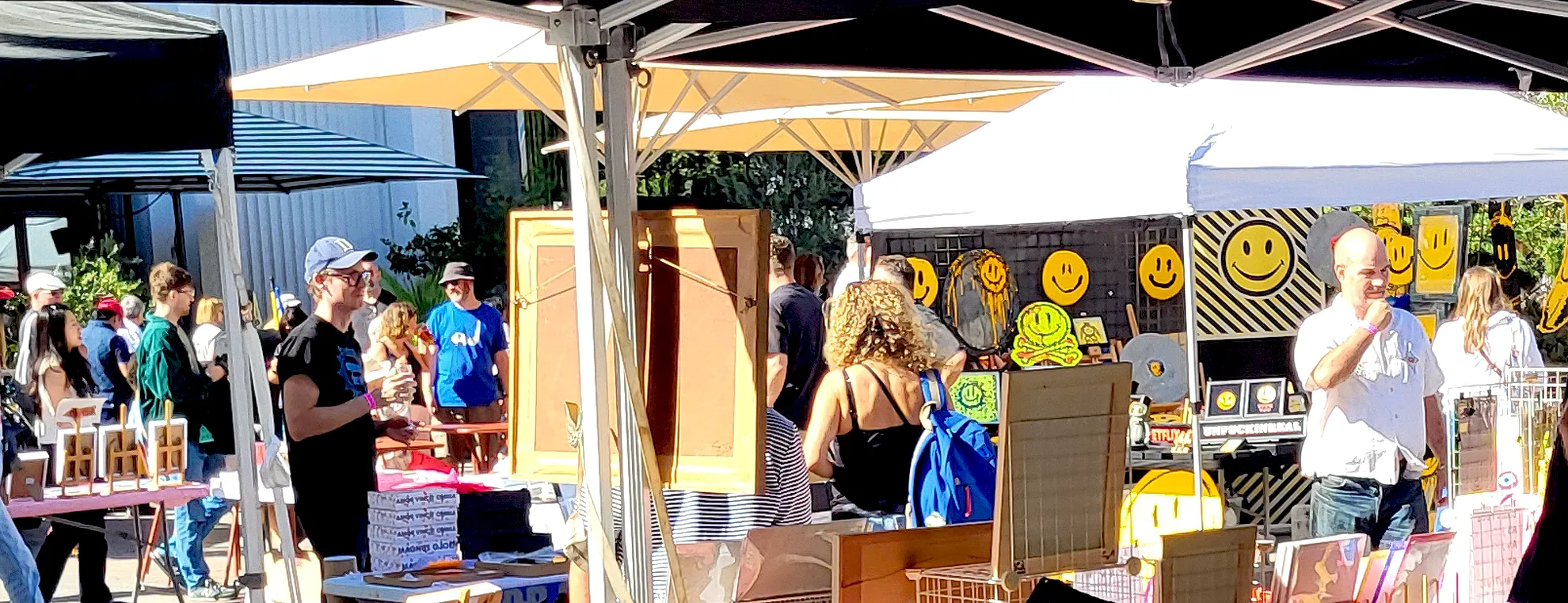
The Art Car Boot Fair is one of those events I'd wanted to visit for years but somehow never had. So when my good friend Nathan, aka Background Bob's dad, offered me a spare ticket on the morning of this year's fair, it should have been an easy yes.
The problem is, as I've got older, I seem to prefer having time to get used to an idea before actually doing it. Even being offered a ticket to somewhere I'd wanted to visit for years wasn't enough to stop me debating whether I should go – but I did finally say yes and I'm really glad I did.
What I found wasn't quite the Art Car Boot Fair I'd imagined. I'd always pictured artists selling work from the backs of cars, but that wasn't the case at all. When the fair began in 2004, it really did involve artists selling directly from car boots, but more than two decades later the format has evolved considerably.
This year's fair took place at King's Cross in London under the theme PLAY FREE, with more than 100 artists taking part across painting, sculpture, photography, prints and original artwork.
An Opportunity to Meet the Artists Behind the Art
One of the things I really liked about the Art Car Boot Fair was being able to meet artists whose work I already knew. It was surprising how often I'd recognise the artwork first, before realising the artist themselves was standing there.
Sara Pope's distinctive painted lips were immediately familiar, as were RYCA's smiley faces. I own one of RYCA's smiley face skateboard decks, so there was something quite nice about finally meeting the person responsible for something that's already hanging on my wall.
There was also some work I was hoping I'd find. I'd previously seen Heath Kane's balloon flowers as part of the Flowers exhibition at Saatchi Gallery and was hoping he might have some of the prints with him. I was very pleased to discover that he did, so one inevitably ended up coming home with me. There was a nice connection between first encountering the work in a major gallery exhibition and eventually buying a print directly from the artist.
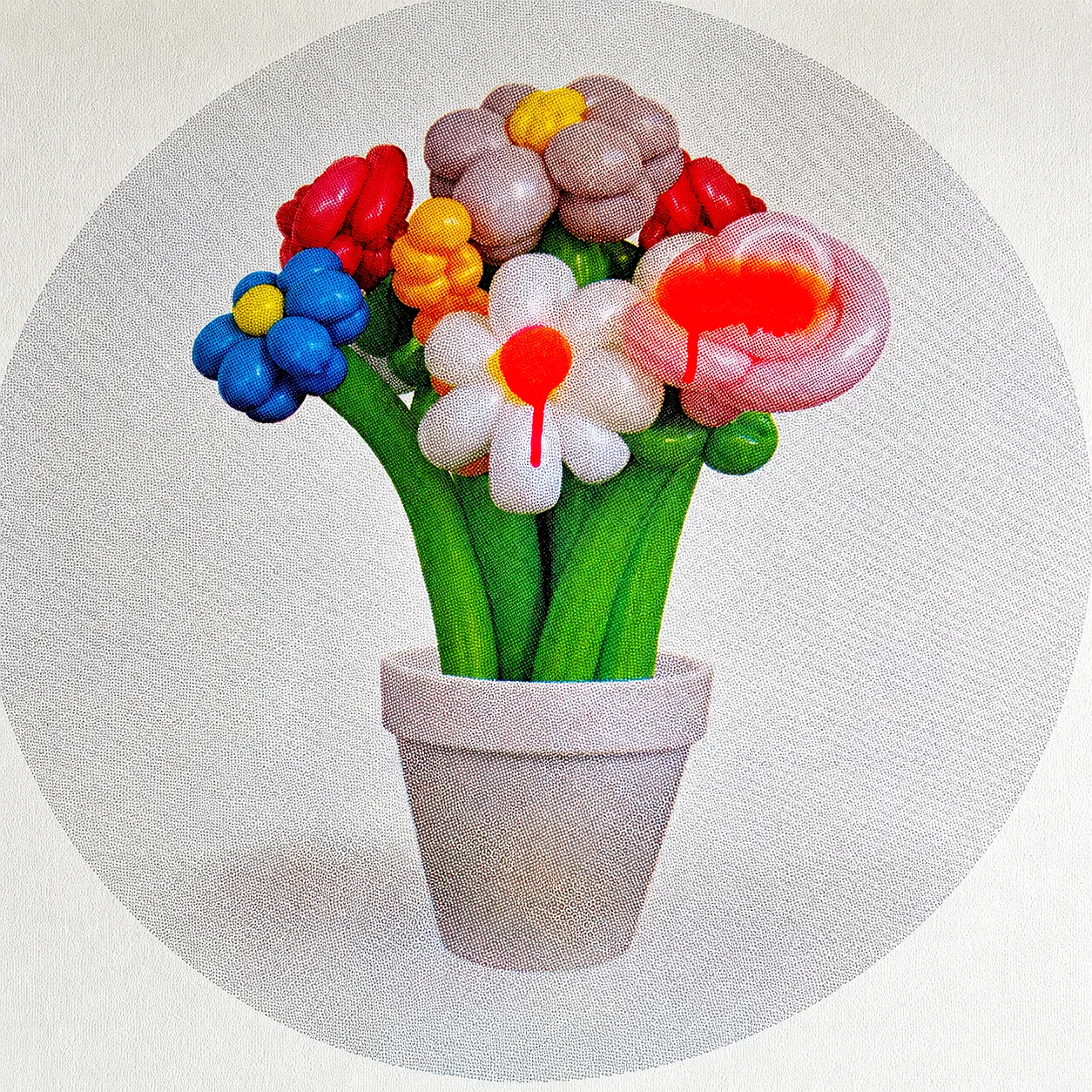
The Heath Kane balloon flower print I bought at the Art Car Boot Fair 2026
But being able to talk to the artists was just as interesting as seeing and buying their work. I've followed Blam and his son Jack from Grow Up Art for a while and had watched their Instagram following grow from around 10,000 to more than 90,000 in a matter of months. Their illustrated fly-posters around London take aim at political figures including Nigel Farage, Elon Musk and Donald Trump. They're topical, provocative and visually difficult to ignore, attracting plenty of attention, both positive and negative.
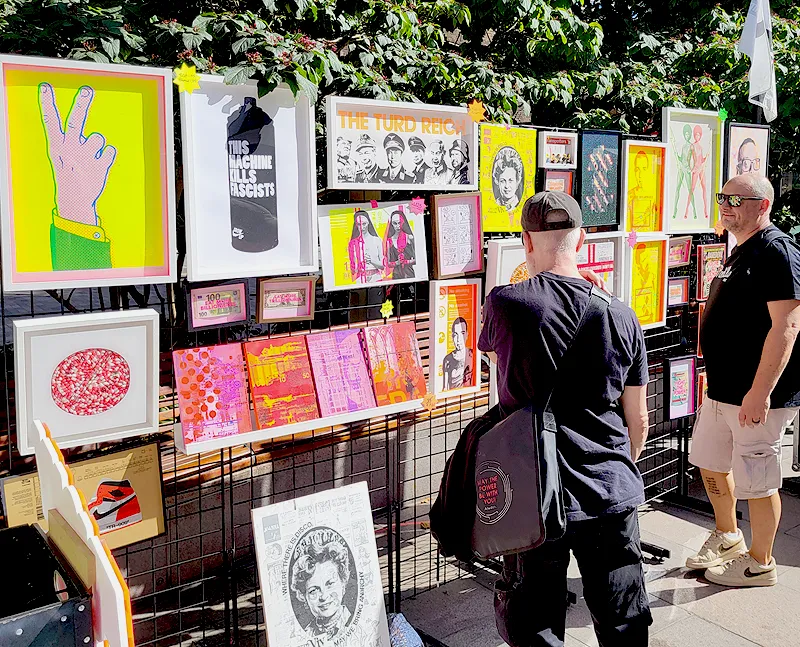
Grow Up Art's stand at Art Car Boot Fair 2026
Sitting down with Blam over a beer gave me the chance to ask something I'd been particularly curious about: had that huge increase in followers actually translated into more opportunities?
The answer was yes. More doors had started opening, including an opportunity for one of his pieces to appear in an upcoming Banksy exhibition. What seemed to surprise him most was just how quickly their following had grown.
I'd recently written about how artists get their work seen and the danger of relying too heavily on social media, so it was interesting to hear directly from an artist experiencing the other side of it. Followers don't automatically equal an art career, but in this case increased attention had clearly created opportunities.
Not everyone I recognised was someone I knew primarily through their art. Jim Moir was exhibiting too, although to me he'll probably always be Vic Reeves. I grew up watching Vic and Bob, so seeing one of my comedy heroes sitting behind a stand selling his artwork was slightly surreal. I've followed his art career as well and, although his work isn't necessarily something I'd put on my own wall, there's no questioning his artistic ability.
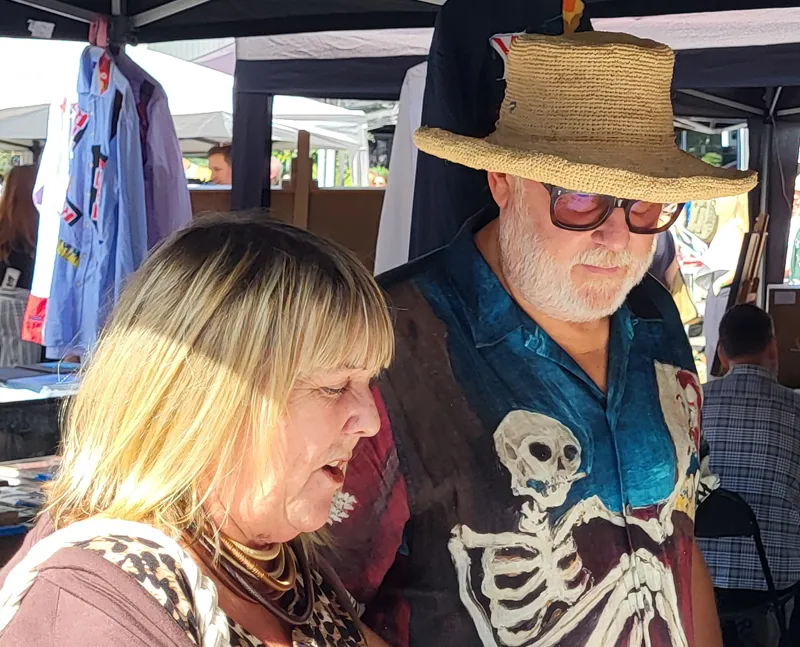
Jim Moir, aka Vic Reeves, at Art Car Boot Fair 2026
I really wanted to ask him for a selfie, but completely chickened out. As I wasn't buying anything, it somehow felt a bit cheeky. So despite him being only a few feet away, I behaved like a sensible adult and simply photographed him. I still wish I'd asked for a selfie.
Making Art Rather Than Simply Buying It
If meeting the artists was one of the things that made the fair interesting, D*Face's stand took that interaction a step further by giving people the opportunity to actually participate in making the art.
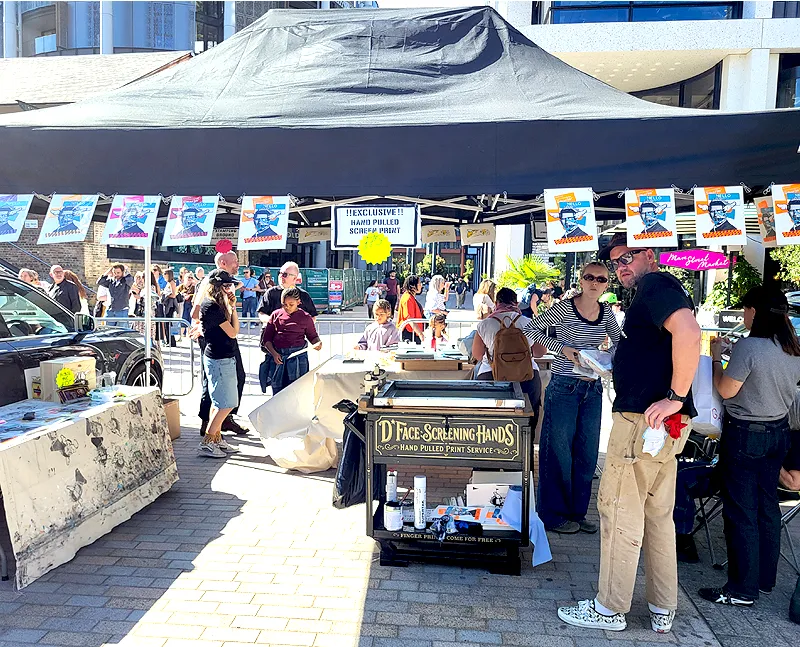
D*Face at his screen printing stand at Art Car Boot Fair 2026
I've admired D*Face's work for years, so his stand immediately caught my attention. There were two different print options available: a pre-printed version for £75 or a DIY block-printed version for £25.
Given the choice between buying the finished print and making one myself, the £25 option was far more appealing.
The process started with a blank piece of card carrying the D*Face logo, followed by four block-printing stations. Flesh colour went down first, followed by yellow, blue and finally black. Each layer revealed a little more of the image, but it was the final black print that suddenly brought the whole thing to life.
The last part was a speech bubble with several phrases to choose from. I went with "Till Death Do Us Art."
What made the process particularly interesting was that the finished prints weren't identical.
Nathan made one too, using exactly the same blocks, colours and process. Comparing them afterwards revealed small variations caused simply by the way we'd printed them. Different amounts of pressure changed the ink coverage, leaving some areas stronger on his and others stronger, or at least different, on mine.
Neither was necessarily better. They were simply ours.
That small amount of variation had already made the print feel more personal than something I'd simply picked up from a stand. Once we'd finished, Nathan pointed out something I'd completely missed: D*Face himself was there signing the prints.
When Does an Artwork Become a Collaboration?
It wasn't immediately obvious that D*Face was there, and some people appeared to complete the printing process and walk away without realising. Had Nathan not spotted him, I could easily have done the same.
When it was my turn, D*Face asked my name and, rather than simply adding his signature, wrote **"Paul × D*Face."**
He explained that he saw the finished prints as collaborations.
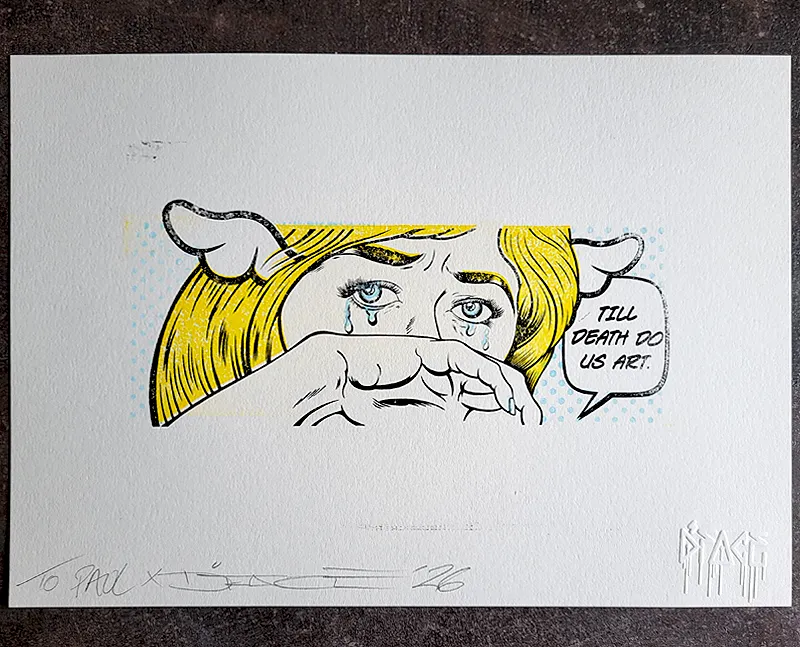
My finished D*Face block print, signed "Paul × D*Face" after he
explained that he considered each print a collaboration
It made perfect sense. I obviously hadn't designed the image or created the printing blocks, but I had physically produced that particular version. The variations caused by the way I applied pressure were part of its creation.
The timing was particularly interesting because I'd just written an article asking whether tracing is cheating in art, looking at tools, process and questions of authorship. A few days later an established artist was happily describing something I'd made using his design and his blocks as a collaboration.
But the more interesting question for me wasn't really who had made the artwork. It was why the finished print now meant more to me.
Had I bought the £75 version, I'd still have a D*Face image I liked. Instead, I can look at this one and remember making it, comparing the result with Nathan's and then meeting D*Face afterwards. Even the imperfections and variations in the printing have become part of that.
I didn't just buy a print, I bought an experience.
Could Participation Add Something to My Own Work?
It made me think differently about what somebody can take away from seeing art in person.
The artwork obviously matters. I wouldn't suddenly value an image I disliked simply because I'd participated in making it. But when there's already a connection with the work, adding an element of participation can create something that buying the same object online simply can't reproduce.
While I was talking to D*Face, he mentioned that the following day he was heading to Milan to paint a huge mural on the side of a building.
I loved the contrast. One day you're essentially manning a market stall in London, helping people make £25 prints. The next you're up a lift painting the side of a building in Milan. An artist's working life can be a strange thing.
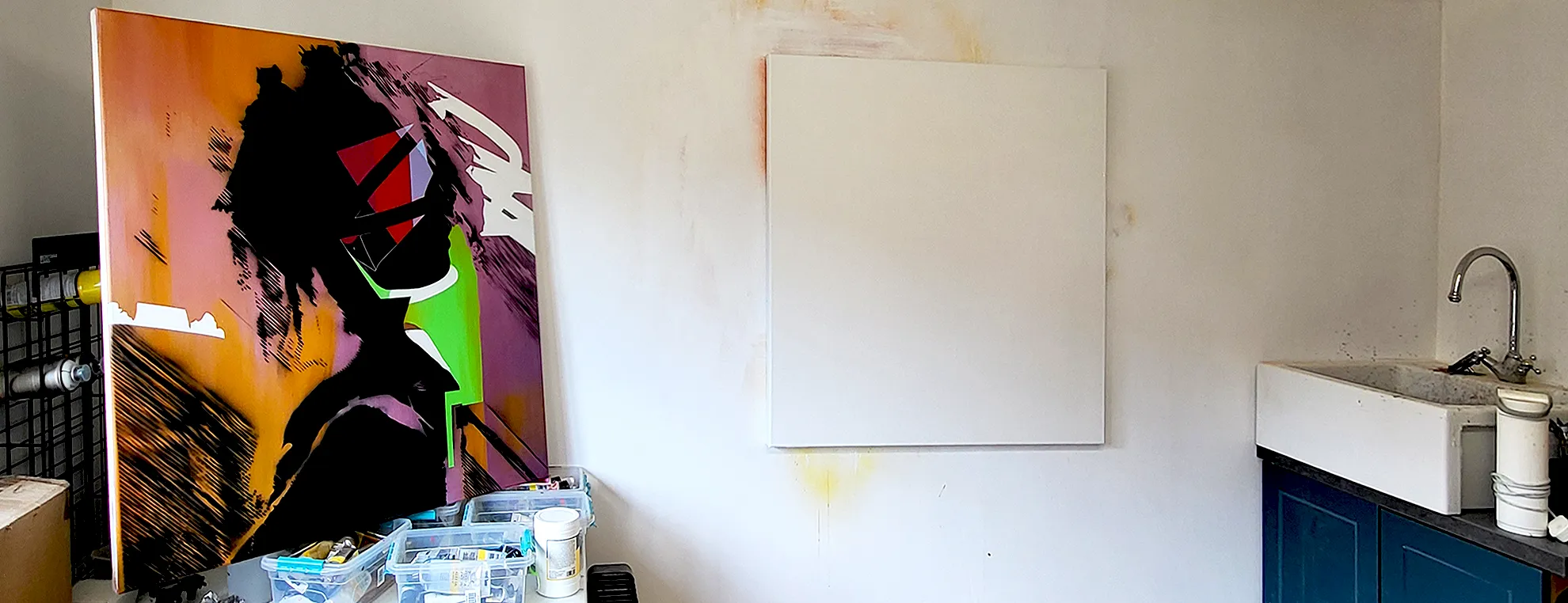
More importantly, the whole experience made me think about my own solo exhibition in Hamburg next year.
The paintings obviously need to remain the focus, but I'd never really considered whether there could be something interactive alongside them. I wouldn't want to reproduce the D*Face idea. Apart from being a fairly blatant copy, block printing doesn't particularly relate to the way I make my own work, but the principle behind it does.
Perhaps there could be four or five elements derived from my paintings that visitors could arrange or combine in different ways. The components would be predetermined, but the decisions made by each person would affect the finished result. Everyone could start with the same ingredients and leave with something slightly different.
For an exhibition called Controlled Disruption, there's something rather appropriate about that.
Whether the idea actually makes it into the exhibition is another matter. At the moment it's simply something I'm playing around with.
But that's probably the most interesting thing I brought home from the Art Car Boot Fair. The D*Face print means more to me because of the experience attached to it, and that has left me wondering whether I can create a little of the same feeling around my own work.
When I mentioned afterwards that I'd almost talked myself out of going, a friend pointed out that perhaps the last-minute invitation had actually worked in my favour. If I'd known about it for weeks, I'd also have had weeks to find a reason not to go.
He may have had a point. Had I declined Nathan's offer that morning, there would be no Heath Kane print hanging on my wall, no D*Face print that I can now say I helped make, no conversation with Blam over a beer and possibly no idea about creating something interactive for my Hamburg exhibition. All of that came from a decision I very nearly didn't make.
I'm not suddenly going to become someone who loves spontaneous plans, but perhaps the day was a small reminder that sometimes it's good to just say yes and see what happens.
Related Articles
From the Studio to Discovery Art Fair Cologne
What happens when artwork leaves the studio and enters the unpredictable world beyond the artist’s control.
From Gallery Walls to Street Walls: A Day of Contemporary Art in London
A reflection on how contemporary art changes meaning as it moves between galleries, streets and public spaces.
When Street Art Leaves the Street: Reflecting on Beyond the Streets at Saatchi Gallery
Exploring what happens when street art moves from public walls into the gallery environment.
Triple Trouble at Newport Street Gallery: A Day in London
A reflection on contemporary art, storytelling and the unexpected connections made through a gallery visit.
Priority Studio Access
I share new paintings, limited edition prints, exhibition news, articles and upcoming projects with subscribers first.
Get updates direct from my studio →
About Paul Kneen
I’m a UK contemporary abstract portrait artist exploring inner noise, quiet pressure and the emotional complexity of modern life through fragmented portraiture and bold colour. I create original paintings and limited edition prints, while also writing about art, exhibitions and the realities of being an artist today. I also share work in progress and life in the studio on Instagram @paulkneenart.


 No spam. Unsubscribe anytime.
