Back in August I spent a lovely afternoon in London with Axel and Anna, the owners of AntiKult Gallery in Hamburg. I’d gone down to meet them while they were visiting the UK and, as I wrote about at the time, we spent the afternoon talking about art, galleries and what might come next. Somewhere amongst all of that, a conversation about a possible solo exhibition became something much more definite – a solo show in Hamburg planned for March 2027. The exhibition will be called Controlled Disruption.
Creating a Body of Work for a Solo Exhibition
As an artist, I find having an exhibition to work towards gives me a focus that creating individual paintings for my website doesn’t quite have. The paintings stop being completely separate pieces and start becoming part of something bigger. You have to think about how they will sit together in the same room, what connects them and, perhaps more importantly, where you want your work to have moved by the time they get there.
I’ve been here before. When I was creating work for my solo exhibition at Peterborough Museum, I had similar feelings, but I also learnt a lot from the experience. That exhibition was curated chronologically, so as you moved through it you could see how the paintings had evolved. I deliberately allowed myself to experiment while I was creating the work, without knowing exactly where I would end up. By the end of the process I’d found a visual language that excited me and, more importantly, felt like me.
This time I’m not starting from a point of wondering what my work should look like because I already have something I want to pursue. But pursuing something doesn’t mean I want to simply repeat the same painting over and over again. For me, it means having a collection of visual elements that I can move around, enlarge, reduce, reveal or hide. The language can remain recognisable while the balance changes from one painting to another.
Earlier this year I wrote about whether an artist’s work can be recognisable without becoming repetitive. That was something I was already thinking about as I started this new body of work. Rather than looking for something completely different, I wanted to see what I could add to the visual language I’d already developed.
Finding More Energy in My Paintings
One thing I kept coming back to was energy. I’ve always loved the energy in Conor Harrington’s work, particularly the looser splats, drips and unexpected marks that run through his paintings. Initially, I think I assumed that if I wanted more of that energy in my own work, I needed to introduce some of the same unpredictability.
The problem is that the way I paint is almost the opposite. I plan things, mask areas, work out compositions and generally try to control what is happening. Introducing marks that I couldn’t completely predict sounded exciting in theory, but it also meant deliberately giving up some of that control.
Thinking about how I could introduce that unpredictability eventually brought me back to stencils. They were a big part of the more socially and politically influenced work I used to make, but over time they disappeared from my paintings and I thought I’d left them behind for good. I didn’t want to suddenly revert to being a stencil artist or recreate something I’d already done, so if they were going to return, they needed to belong within the work I’m making now.
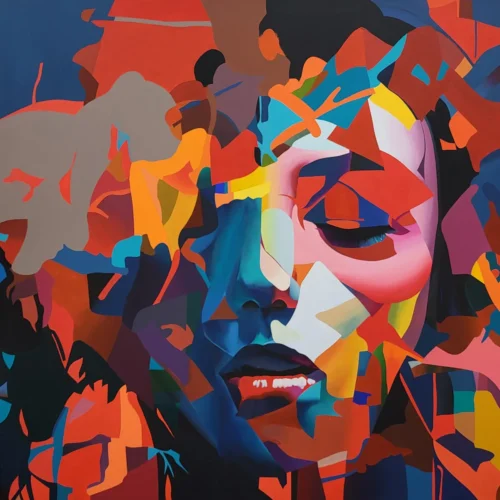
I initially tried using them in the traditional way, with spray paint. It gave me the unpredictability I thought I was looking for, but the painting itself didn’t go to plan. I liked elements of what was happening, just not enough of them, and eventually decided to start the painting again. I’ve written before about that decision and whether starting a painting again is really the same as giving up.
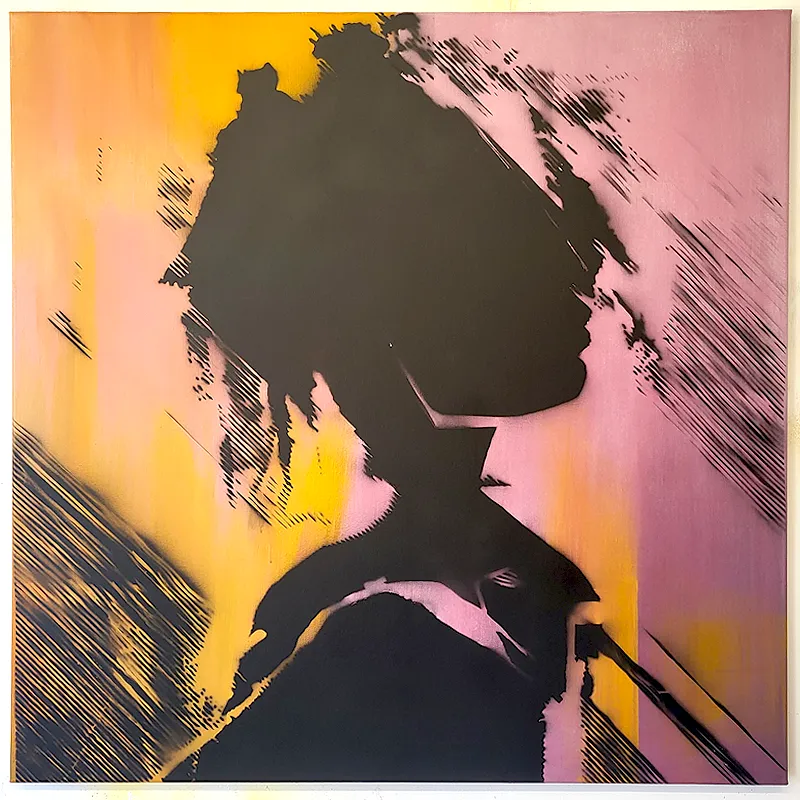
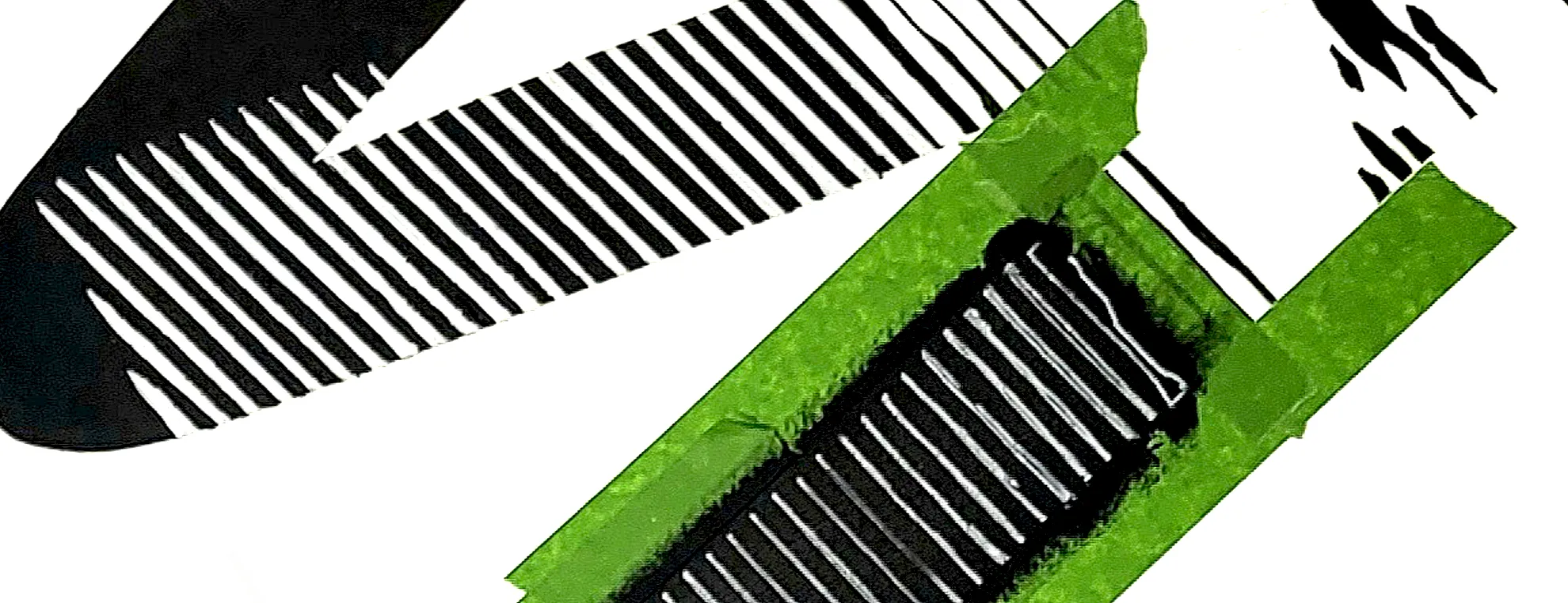
My first attempt at bringing stencils back into my work, using spray paint before deciding to start the painting again
What I didn’t want to abandon was the stencil itself. There was something about having that additional imagery moving through the portrait that still interested me, so I started thinking about how I could use it differently. Eventually I decided to hand-paint it instead.
Which, rather ironically, gave me complete control over it again.
I like the idea of losing control, but apparently only on my own terms.
From Halftone Stencils to Urban Art Influences
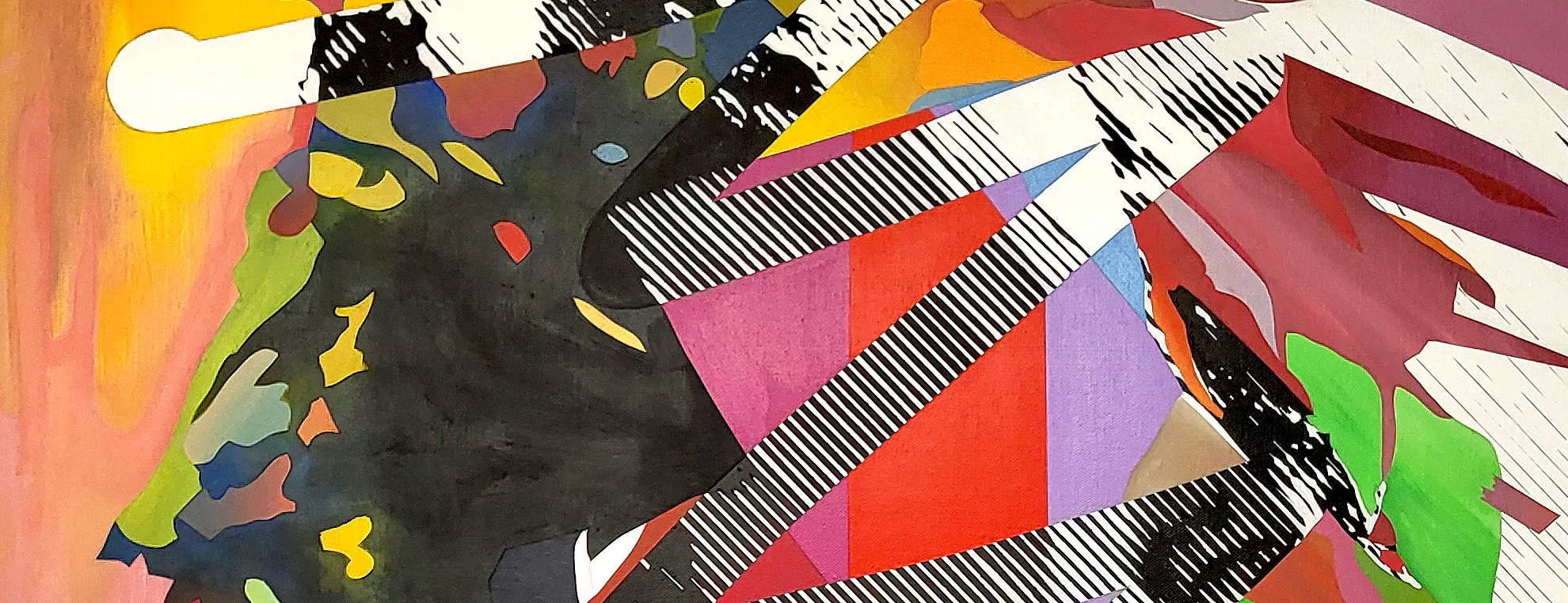
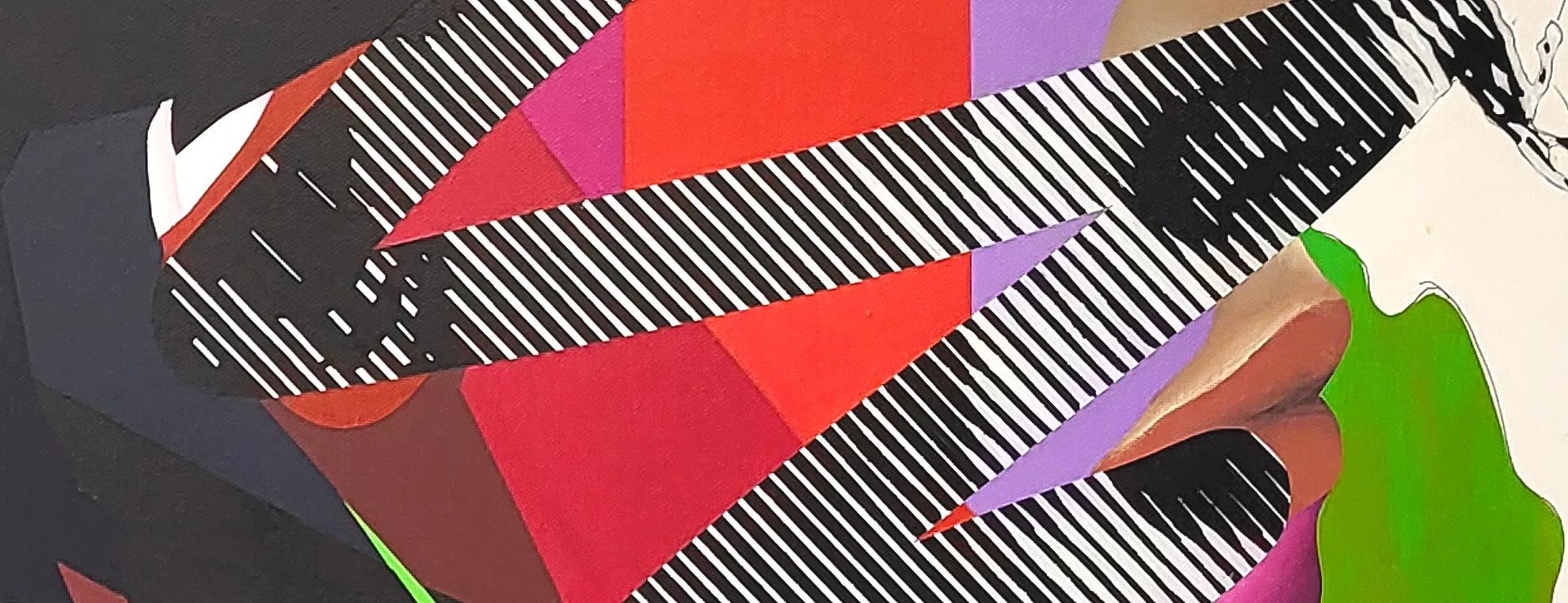
Once I’d decided to hand-paint the stencil, it also opened up the possibility of making it much more detailed. I’ve been a fan of the street art duo SNIK for a long time and have always liked the intricate halftone effect that appears in their work. It wasn’t something I’d tried before, but it seemed particularly suited to what I was doing because I don’t need to show an entire stencil image. I can reveal small sections between the other elements of the painting and there is still enough information within those fragments for the detail to come through.
As I started incorporating those halftone stencils, they began to do something I hadn’t necessarily anticipated. Rather than feeling like another layer sitting on top of the painting, the stencil started to weave in and out of everything else. Parts appear and then disappear behind areas of the portrait or geometric shapes before emerging somewhere else. At times it almost feels as though the stencil has been underneath the painting all along and sections of it are only now being revealed.
There is another influence in there that I hadn’t really connected with the paintings until recently. I’ve always loved old billboard posters, particularly when they’ve been left long enough to start deteriorating. New posters are pasted over old ones, layers build up and, as they tear and decay, fragments of what was underneath begin to show through. Eventually you’re looking at something that was never designed as a single image but has become one through the accumulation and loss of all those different layers.
What I’m doing isn’t quite the same, but there is something of that in these paintings. The halftone stencil appears in fragments, disappears behind other elements and then reveals itself again somewhere else. I’ve been an admirer of street art for a long time, which is probably fairly obvious from artists such as SNIK and Conor Harrington appearing elsewhere in this article. Bringing stencils back into my work seems to have allowed some of those urban influences to find their way into the paintings too.
Combined with the fragmented portraits and geometric shapes, I think it gives the new work a slightly more urban feel. What I like is that it doesn’t feel as though I’ve borrowed a street-art aesthetic and applied it to my paintings. These are influences that have been around me for years, but they’re finding their way naturally into the visual language I’ve already developed.
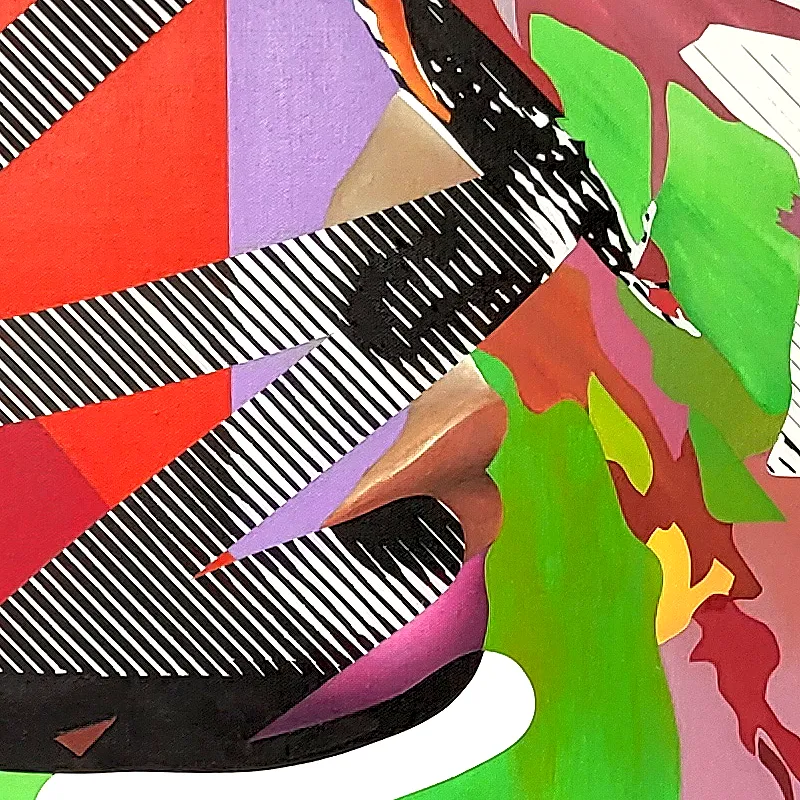
A closer look at the hand-painted halftone stencil alongside the more natural flesh tones introduced into the new work
I particularly like that idea because, in some ways, it mirrors what has happened in my work. Something I thought I’d left behind years ago has found its way back, but it doesn’t feel as though I’ve gone backwards. The stencil has returned in a different form and is now working alongside everything I’ve developed since.
And somewhere in that process I realised I’d found the energy I’d been looking for in the first place.
What I admired in Conor Harrington’s paintings wasn’t really the splats and drips themselves; it was what they did to the work. They bring energy and movement to his paintings, and within his visual language they work brilliantly. I’d initially thought I needed some of that looseness to achieve something similar in mine, but the halftone stencil has given me that energy in a way that feels much more natural to my own work. I’ve found my own way of achieving the thing I admired rather than simply borrowing the way somebody else achieves it.
Why Controlled Disruption Feels So Appropriate
The title Controlled Disruption is beginning to feel increasingly appropriate. It describes what is happening within the paintings, but I’m starting to realise it also describes the way I work. There is plenty of disruption in the finished pieces – fragmented faces, geometric shapes, areas appearing and disappearing and now the stencil weaving through everything – but very little of it is actually accidental. I plan, mask, adjust and make decisions about where things sit, even when I’m trying to make the result feel less controlled.
There’s a slight irony in the fact that I went looking for something more unpredictable and somehow ended up developing another element that I can painstakingly control. Perhaps I just need to accept that even my disruption needs to be organised.
Interestingly, adding that extra energy has also made me want to introduce more calm elsewhere in the paintings. I’ve found myself moving parts of the face in almost the opposite direction, introducing more realistic facial details and more natural skin tones, although they still only appear in relatively small, fragmented areas.
With geometric shapes, blocks of colour and detailed halftone imagery all competing for attention, I think the paintings need those quieter moments. If everything were abstracted, patterned or brightly coloured, there is a danger that the work could simply become too busy. Those more natural areas of skin give the eye somewhere calmer to land, while sometimes only a nose, an eye or part of a mouth remains visible. I like that contrast between a small piece of realistically painted face and everything happening around it.
Developing a Collection Without Repeating Myself
What I now have is a collection of elements I can play with rather than a set formula. One painting might contain considerably more stencil imagery while another may only reveal small fragments. More of the face might be visible in one and almost disappear in another. The amount of realism, colour, geometric abstraction and halftone detail can all shift, while the same visual language continues to run through the collection.
For this exhibition, I think that is enough development. I don’t want to spend the next six months continually searching for another new technique or adding things simply for the sake of making the work different. I’ve got enough things in my armoury to play with. What interests me now is seeing what happens when I change the balance between them.
There is also the practical reality that I have a deadline. Experimenting when you have no particular destination is very different from experimenting when you know there is a gallery in Hamburg waiting for a body of work. Every painting still involves a ridiculous number of decisions and there will inevitably be things that don’t work, but I can’t spend the next six months disappearing down every possible path just to see where it leads. At some point I do actually have to produce the paintings.
I don’t necessarily think that pressure is a bad thing. If anything, it gives the decisions a little more purpose. I need enough cohesion for the paintings to belong together without creating a collection where every piece feels like a variation of the one before it. I want someone familiar with my work to recognise the paintings as mine while still seeing that something has changed. I’m not trying to abandon what I’ve been doing or suddenly reinvent myself; I’m trying to build on what I’ve learnt and push it somewhere new.
Can a Solo Art Exhibition Change the Way You Work?
So, can a solo art exhibition influence your work? I think it can, although perhaps not in the way I might have expected. I have no way of knowing whether I would have arrived at exactly the same paintings without Hamburg sitting in the diary, and I probably would have continued experimenting and developing the work anyway. The biggest influence has probably been on the way I think about the work as a whole. I’m no longer making one painting and wondering what comes next; I’m thinking about how that painting might sit alongside another ten or fifteen, what connects them, how much they can differ and still belong together, and where I want the work to have reached by the time it fills a gallery.
It also means that every decision has a slightly bigger consequence. If something works, I can think about how it might develop across the next painting. If it doesn’t, I need to figure out why and move on. There is a strange mixture of freedom and pressure in knowing that the work can still evolve while also knowing that at some point in March it has to stop evolving long enough to hang on a wall.
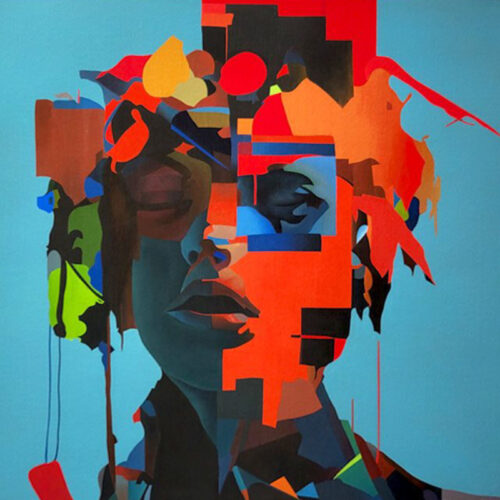
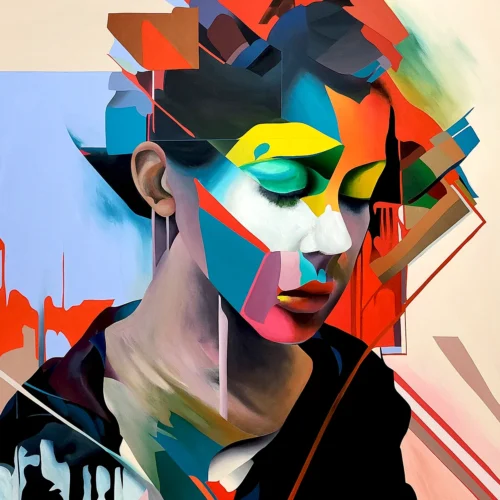
I’ve finished the first painting, Still In There Somewhere, and I’m already working on the next. I have no idea exactly what the final few paintings will look like yet, and I don’t think I want to. I have enough elements to explore now without feeling that I need to keep inventing new ones.
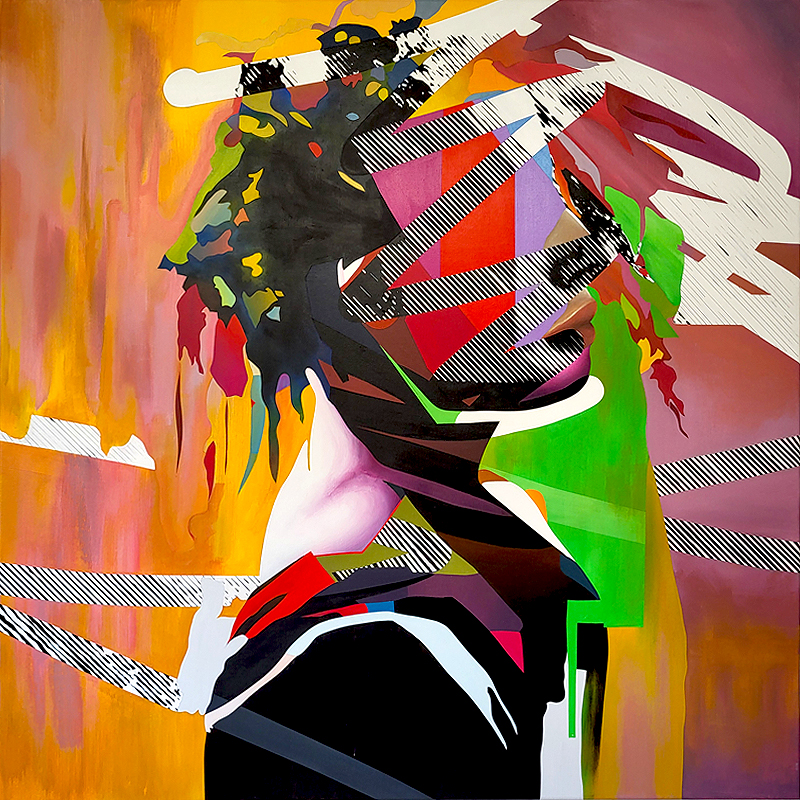
Still In There Somewhere – the first finished painting from the new body of work for Controlled Disruption
Six months from now they will all be together in Hamburg for Controlled Disruption. Between now and then I get to find out exactly what that body of work will become. I’m excited to see where it goes, slightly daunted by how much there is still to do and increasingly resigned to the fact that, despite all my attempts to introduce a bit more chaos into my paintings, I’m probably going to insist on controlling every last bit of it.
Related Articles
From Gallery Walls to Street Walls: A Day of Contemporary Art in London
A reflection on how contemporary art changes meaning as it moves between galleries, streets and public spaces.
Why I Still Use Masking Tape in My Paintings
Discover how the process behind my paintings became connected to the ideas they explore.
When Street Art Leaves the Street: Reflecting on Beyond the Streets at Saatchi Gallery
Exploring what happens when street art moves from public walls into the gallery environment.
Why I Paint Abstract Portraits: Exploring Emotion Through Structure
Discover why the human face remains at the centre of my work and how abstraction helps explore complex human experiences.
Priority Studio Access
I share new paintings, limited edition prints, exhibition news, articles and upcoming projects with subscribers first.
Get updates direct from my studio →
I’m a UK contemporary abstract portrait artist exploring inner noise, quiet pressure and the emotional complexity of modern life through fragmented portraiture and bold colour. I create original paintings and limited edition prints, while also writing about art, exhibitions and the realities of being an artist today. I also share work in progress and life in the studio on Instagram @paulkneenart.



 No spam. Unsubscribe anytime.
