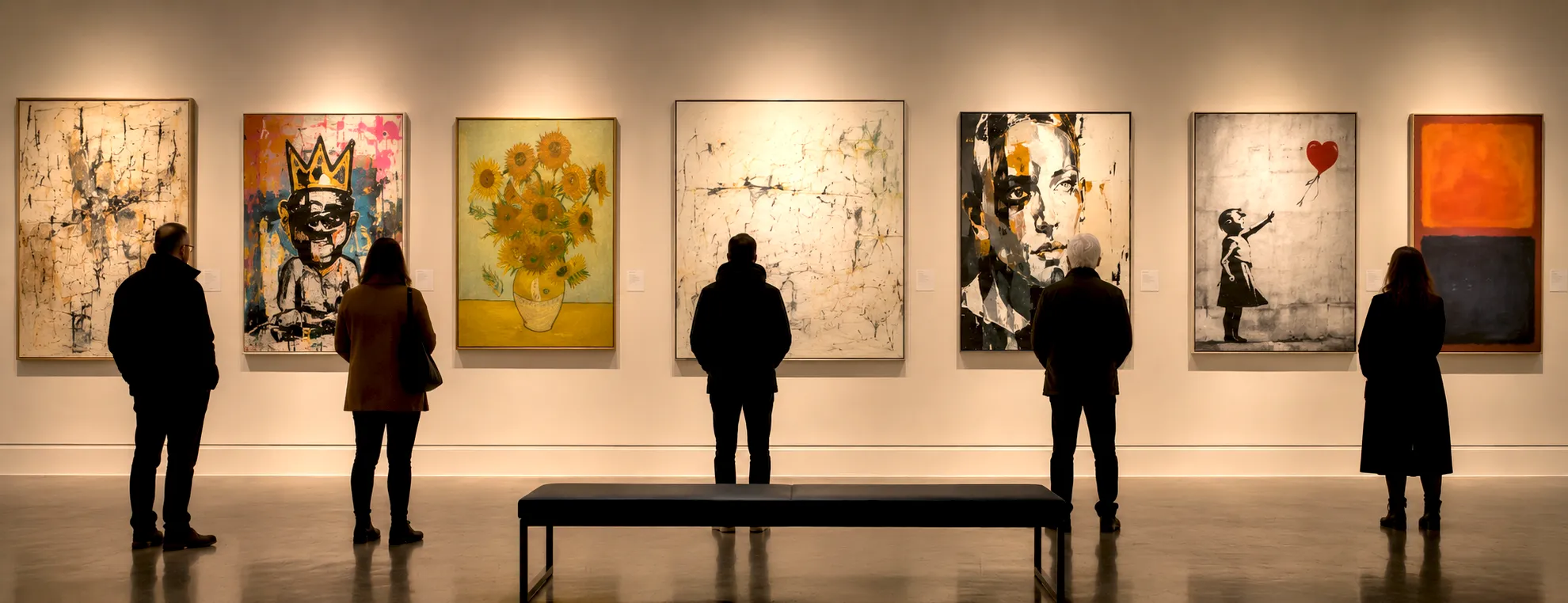
Last week I had a meeting to discuss displaying some of my paintings in a public space. On paper it sounded like a good opportunity. Around 200 people pass through the building every day and my work would be displayed on the walls and available to buy.
The meeting went well and most of my questions were answered but there is one question that only I can answer…
Is this the right opportunity?
On the surface, saying yes feels like the obvious decision. I have paintings wrapped up in my studio so hanging them somewhere people might actually discover them is surely the logical answer. That alone feels like a good enough reason to accept the offer. The trouble is that another question also refuses to go away…
Is it a good fit for my work?
Those two questions sound similar, but I don't think they are. One asks whether an opportunity has value. The other asks whether it belongs at this stage in your art career. The answer to that question can change over time, even if the opportunity itself hasn't. I've found that's true of a lot of things as an artist, including the way I think about my own painting style.
Why saying yes can get harder
When you're starting out as an artist, the answer feels relatively simple. You say yes to almost everything because you're trying to build momentum. You want people to see your work, you want experience and you have no idea where an exhibition, conversation or introduction might lead. Every opportunity feels like a step forwards because you're simply trying to get moving.
What nobody tells you is that there comes a point where saying yes isn't quite so straightforward.
A few days before the meeting I’d watched an interview with an actor who said that, early in their career, they accepted almost every role they were offered. As their career developed, they became much more selective. Not because they believed they were above certain roles, but because every decision became part of a much bigger picture. That immediately made sense to me because I don't think artists become more selective through arrogance. If anything, they're trying to build something coherent. Every exhibition, every gallery, every collaboration and every opportunity gradually becomes part of the story you're telling about your career.
Some decisions feel straightforward. If Tate Modern, for example, invited me to exhibit tomorrow, I probably wouldn't spend long weighing it up. Most artists would see that as a significant step forwards. It's everything in the middle that's difficult because those opportunities don't always come with an obvious answer.
There is no handbook
Despite the many social media ads claiming they’ve cracked the art world, there isn't an artist's handbook explaining which opportunities to accept and which ones to decline. Two artists could be offered exactly the same opportunity and make completely different decisions. One might accept because they're trying to build relationships with galleries. Another might decline because they're focusing on growing their own audience online. Someone else might simply need the income, while another might value the experience more than anything else. None of those decisions is automatically right or wrong because none of those artists is trying to build exactly the same career.
And I think that's something we often forget. It's easy to look at another artist's career and assume they've found the formula. We see the exhibitions they announce, the galleries they join and the opportunities they celebrate, but we rarely see everything they've turned down. We don't know what they're trying to achieve, what compromises they've made or which decisions they later regretted. Looking at somebody else's career and assuming the same choices would work for our own doesn't really make sense because we're not all trying to reach the same destination.
One thing I do know is that I don't want my career to rely on one thing. I don't want galleries instead of my website, or exhibitions instead of writing articles. I don't want consultants instead of selling work directly. I want all of those things working together because each one reaches people in a different way. Someone might discover my work through an article, another through an exhibition and another through a gallery. If they're all introducing people to the same paintings, I don't see them as competing with one another. They're simply different routes to the same destination.
That's why this meeting stayed with me. It wasn't because it was the biggest opportunity I've ever been offered, or because saying yes or no would define my career. It stayed with me because it exposed a question I'd never really put into words before.
What does moving my career forwards actually look like?
Artists spend years learning how to paint. We study composition, colour, materials and technique, but very little time is spent learning how to make career decisions. Nobody teaches you how to recognise a good fit. Nobody can tell you whether one opportunity is moving your career forwards while another is taking you sideways. Most of the time you're making the best decision you can with the information you have, then discovering much later whether it was the right one.
Maybe that's what experience really gives us. Not certainty, because I don't think certainty exists, but judgement. Every exhibition, every rejection, every sale, every conversation and every mistake becomes another reference point. Over time you begin to understand not just the kind of work you want to make, but the kind of career you want to build. Those two things aren't always the same, and recognising the difference is probably one of the most valuable lessons an artist can learn.
I still don't know whether I'll say yes to this particular opportunity. Maybe I will and maybe I won't, but I don't think that's the most interesting question anymore. The more interesting question is whether I'm making that decision for the right reasons. Not because somebody else would approve, not because it looks impressive from the outside and not because it's what another artist might do, but because it genuinely feels like the right fit for the career I'm trying to build.
Every artist is trying to build something different, so it probably makes sense that we all make different decisions along the way.
The meeting didn't answer the question I came home with.
It simply helped me realise I was asking the right one.
Related Articles
How Do You Know When a Painting Is Finished?
Knowing when to stop painting isn't so different to knowing which opportunities to accept. Both rely on judgement rather than certainty.
What Makes Good Art?
Exploring why there isn't a single right answer in art, just as there isn't one path through an artistic career.
Artist Inc: When Painting Isn't the Only Job
A look at the many roles artists juggle while trying to build a sustainable creative career.
Why I Paint Abstract Portraits: Exploring Emotion Through Structure
Discover why abstract portraiture became the right direction for my work, and how questioning your own decisions can shape an artist's career.
I’m a UK contemporary abstract portrait artist exploring inner noise, quiet pressure and the emotional complexity of modern life through fragmented portraiture and bold colour. I create original paintings and limited edition prints, while also writing about art, exhibitions and the realities of being an artist today. I also share work in progress and life in the studio on Instagram @paulkneenart.